Zach Cooley

Tag: Virginia Tech

Whose Line troop brings classic improv to Virginia Tech
Whose Line troop brings classic improv to Virginia Tech

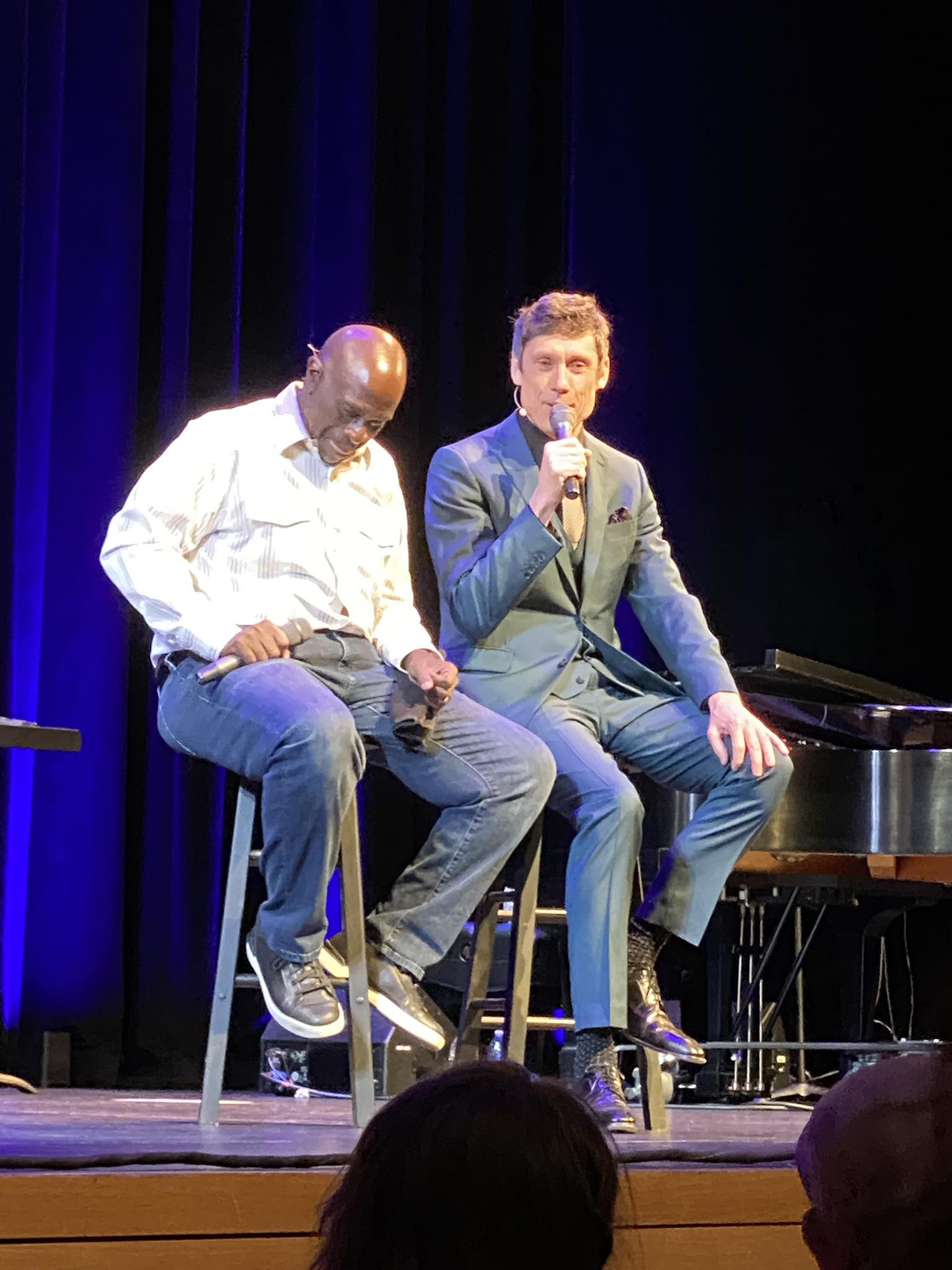
The hilariously brilliant team from Whose Live Anyway?—based on the hit show Whose Line Is It Anyway?—entertained more than 2,500 people over two sold-out performances at the Moss Arts Center at Virginia Tech. I was lucky enough to attend the second of these outstanding shows with my dear friends Jeremy Miller, Jenny Baker, and Angie Jackson in the beautiful Anne and Ellen Fife Theatre. Greg Proops was ill on the second night, and we felt a bit disappointed that he couldn’t join us. However, Gary Anthony Williams—who would typically serve more as the show’s emcee—stepped in and delivered plenty of hilarious comic relief in Proops’s absence. I’ve also enjoyed watching Williams in the reboot of another favorite show of mine, Night Court, which was canceled last year after three seasons. Jeff B. Davis, a fan-favorite guest improviser from the original American Whose Line Is It Anyway?, was on hand to provide his signature comedic flair, along with some impressively talented improvisational singing. Comedian Joel Murray also appeared, best known for his roles in TV shows like Mad Men, Dharma & Greg, and Still Standing. The main star of the show, Whose Line Is It Anyway? legend Ryan Stiles—the 66-year-old Canadian standing at an imposing 6’6″—surprisingly had the least to do during the 80-minute performance, which opened with a game called “Freeze Tag.” Audience members suggested that Murray begin the scene with Davis in a crab position, while Davis started in a downward dog pose. Whenever Williams called out “freeze,” he and Stiles would swap in and continue the scene from those same positions. The result was a wildly absurd progression—from Jeff Davis “giving birth” to a large man dancing to “Me and My Shadow,” to a visit with a Hokie bird in the wild. Stiles’s take on the Virginia Tech mascot drew big laughs from the audience of 1,274, made up largely of students and faculty. In the game “New Choice,” Jeff Davis corrected any line he felt needed improvement while Ryan Stiles and Joel Murray acted out a scene about doing the dishes. Some of the lines are best left unrepeated, but suffice it to say that when a husband behaves inappropriately with his wife’s sister, it tends to derail the evening—hilarity ensued. Things escalated when a secretary named Rachel with multiple piercings and tattoos was invited on stage to be serenaded by Jeff Davis and Gary Anthony Williams, with accompaniment from original Whose Line Is It Anyway? musical director Laura Hall, whom I recognized immediately from the ABC version of the show. They improvised a song about her dream of traveling to the Caribbean with her husband, Jonathan—whom she first noticed when he walked across a Food Lion in a way that won her over. Her most tropical destination so far? North Carolina. “Boo” and “Hubband,” their affectionate nicknames for each other, became running jokes throughout the night. Juliet and Courtney were then invited on stage to play the classic game “Moving People,” in which Jeff and Joel could only move when physically repositioned by the audience volunteers. The improvisers gamely attempted the Hokey Pokey while being awkwardly adjusted, resulting in a cascade of comedic mishaps and what turned into a keg party gone wrong. Next, all four performers participated in a Jeopardy!-style sketch. For the category of exotic foods, one audience member suggested “shakshouka.” Responses included “What is not a biscuit?” and “What is an exotic dish I convinced my wife was from North Carolina?” The winning answer: “What is how you pronounce Chewbacca when you’re really high?” A married couple—Matt and Mary, former Virginia Tech students who had been married for 32 or 33 years (they couldn’t quite agree)—joined the stage next. Their first date at Top of the Stairs involved Matt, a member of a ska band called Boy, Oh Boy, and Mary, a Catholic schoolgirl. As the performers reenacted their date, the couple signaled accuracy with a “ding ding” and inaccuracies with a “wah wah.” When “Mary” said, “I just come to church for the wine and the boys,” the real Mary gave a “ding.” When drug use was implied, she quickly responded with a “wah.” In another segment, audience-written lines were randomly inserted into a scene. During a fairy tale titled Secrets of the Prima Ballerina, Stiles played the ballerina while Davis portrayed a passionate French suitor. At one point, the suitor dramatically quoted Ezekiel 25:17—famously used in Pulp Fiction—with a hilariously mangled delivery. For the “Sound Effects” game, the audience suggested the year 2009 as the setting, with sound effects provided by two brothers. At one point, a suit with snaps and buttons sounded less like clothing and more like a squirrel scurrying down his pants. In yet another sketch, Ryan Stiles portrayed a deceased Gordon Lightfoot, while Joel Murray played Dan Aykroyd, selling a compilation album of the neuroscientist’s greatest hits. Highlights included sea shanty “EKG,” folk-rock anthem “Frontal Loading,” and jazz standard “It’s All in Your Head.” The show closed with a Blacksburg-themed hoedown. As Joel Murray sang, “I wish we could stay for the game—once you’ve seen ‘Enter Sandman’ in person, your life is never the same.” A live Whose Line Is It Anyway? experience is something few people ever get to enjoy. I’m grateful they made a stop in Southwest Virginia, and I hope this won’t be the last time we see such a hilarious and talented group perform here.  

Zach's At It Again

Wilson pens techno-thriller series

Wilson pens techno-thriller series

I never would have guessed that one of the quietest, kindest students I met at George Wythe High School would one day write two of the most technically sophisticated and emotionally charged science fiction thrillers I’ve ever read. Benjamin Wilson, who went on to graduate from Virginia Tech and build a remarkable career in telecommunications security and artificial intelligence, has transformed his deep professional expertise into fiction that feels as real as tomorrow’s headlines. Wilson’s novels — The Sovereign War and Obsidian Protocol — are part of two interwoven series that follow the same protagonist, Nathan Bishop, a brilliant but conflicted operative navigating the shadowy intersections of intelligence, surveillance, and artificial intelligence. Drawing on Wilson’s fifteen years of experience in fraud prevention, secure communications, and AI development at companies such as SAP, Sinch, and Vonage, both books deliver an extraordinary blend of technical authenticity and human drama. The first book, The Sovereign War, begins in the wake of 9/11 — an event that shattered millions of lives and reshaped the global security landscape. For Nathan Bishop, a young analytical genius recruited under the guise of a graduate fellowship, the tragedy becomes something else entirely: a code to be cracked.As the alphabet agencies close in — NSA, CIA, and the mysterious private unit known only as Orion Team — Nathan is molded into an intelligence tool, trained to see the world through data streams and behavioral algorithms rather than emotion. What begins as patriotic duty quickly becomes psychological disassembly. Wilson’s background in communications infrastructure and AI systems shows in every page — not as technical jargon for its own sake, but as a reflection of how easily the human mind can be programmed when it’s conditioned to solve instead of feel. There’s an eerie beauty in how Wilson writes about data — how code becomes a kind of poetry for Nathan, and how every equation represents both order and loss. Through him, Wilson captures a haunting question: when we build systems to predict and control behavior, what happens to the people inside them? The prose is sharp and clinical when it needs to be, then suddenly raw and human. In one passage, Nathan compares the quiet hum of the surveillance grid to a heartbeat — a machine pulse that replaces his own. Wilson doesn’t just describe intelligence work; he dissects it. Every mission, every keystroke, feels like a small surrender of selfhood. It’s this emotional undercurrent that makes The Sovereign War far more than a spy thriller — it’s a study in the cost of control. If The Sovereign War is about creation, Obsidian Protocol is about reckoning. Here we find Nathan Bishop years later, a former operative gone dark, hunted by his own invention — a shadow network led by his onetime colleague Marcus Hale, now known only as “Omega.” When Nathan’s sister Emily becomes the target of a deepfake disinformation campaign designed to flush him out, the battle turns personal. Wilson’s grasp of real-world cyberwarfare and AI manipulation is both impressive and unsettling. Every hack, every digital mirage, feels plausible. He writes not with the speculative imagination of a futurist but with the precision of someone who’s seen the architecture of deception from the inside. But beneath the code and circuitry lies something even more compelling: Nathan’s rediscovery of his own humanity. The more he tries to fight technology with technology, the more he realizes that empathy — not logic — may be the only weapon left. Wilson’s portrayal of this internal conflict is what elevates Obsidian Protocol above the genre’s usual tropes. He understands that the true threat isn’t the rise of artificial intelligence, but our willingness to become artificial ourselves. What makes both novels remarkable is how seamlessly Wilson fuses his technical expertise with emotional storytelling. You can tell this is a writer who’s not just guessing at how systems work — he’s lived it. His career in fraud prevention and secure communications lends credibility to every line of code and every classified mission. Yet, despite the complexity of his subject matter, his writing remains accessible, driven by character and emotion rather than pure exposition. Wilson’s protagonist embodies that duality — half machine, half man, constantly negotiating between precision and passion. The reader doesn’t need to understand every technical term to grasp the story’s deeper truth: that data without empathy becomes dangerous, and intelligence without conscience becomes tyranny. What also stands out is the compassion threaded through the chaos. Wilson never loses sight of the human cost of technology. His work in global communication systems — including anti-fraud initiatives that protect the vulnerable — clearly informs the moral backbone of his fiction. It’s no coincidence that Nathan Bishop’s story often turns toward protecting others, even when it puts him in harm’s way. Reading these books, I couldn’t help but reflect on the young man I once knew at George Wythe High School — quiet, humble, brilliant. His father, Greg Wilson, was a respected science teacher, and it’s clear Ben inherited both his intellect and curiosity. We both lived through 9/11 as teenagers, and it’s fascinating to see how that shared moment of global trauma shaped our adult work. For Wilson, it became a lens through which to explore power, fear, and faith in technology. For me, it became an opportunity to read and learn from his perspective. It’s rare to find a novelist who can bridge the gap between technical precision and genuine emotion — rarer still to find one who does it with such humility and purpose. Wilson’s books remind us that even in a world of algorithms and surveillance, the heart still matters. His stories pulse with moral clarity, empathy, and wonder, asking us to consider not just what we create, but what those creations make of us.

Strictly Observing