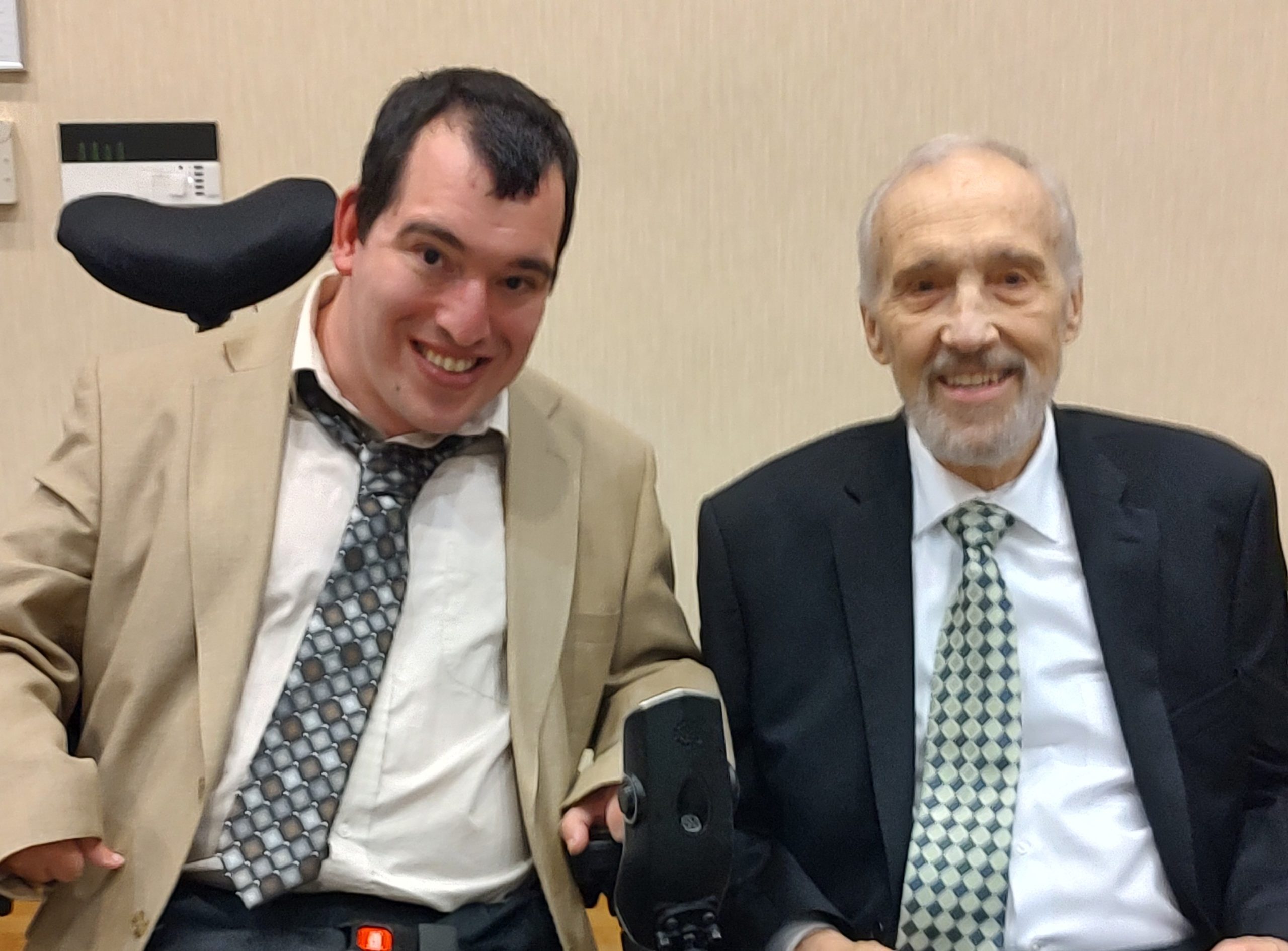
Zach Cooley

Month: November 2025

A ride to remember

A ride to remember

When your best friend offers you a ride on his tractor, you take him up on it—especially when all the riding you usually do is in your own power wheelchair. Jacob Sharitz and I have known each other for more than half our lives, and for most of that time, I’ve been privileged to call him the best friend I’ve ever known. He has been there for me in both the brightest and darkest moments of my life, performing acts of friendship that no one should ever have to ask of another—and doing it all with grace, kindness, and humility. Jacob is one of the finest human beings I have ever had the blessing of encountering. The fact that he could lift my 180 pounds of dead weight into a cherry-red Massey Ferguson tractor—complete with cab—without putting either of us in the hospital is a miracle in itself. Yet he did it with effortless ease, giving me a view of farm life I’d never seen before. The mountains of Wythe County are beautiful from any angle, but they are especially breathtaking when seen through the windshield of a tractor or a side-by-side. Jacob is a seventh-generation farmer on the 250 acres he and his family own, and it’s easy to see why he enjoys the farm life as much as he does. “I love my moos,” he said affectionately, referring to the hundreds of cattle he feeds and tends to daily. “My farm life gives me time to myself after talking to people all day long.” Our tour included a stop to see one of Jacob’s favorites: Pumpkin, a cow he bottle-fed after returning home from college in 2013. Now older and feeble, she still gets special treatment. Jacob gently nudges her along, making sure she gets safely through the gate for feeding. “Nothing upsets me more than when I’m trying to feed these cows and they just won’t listen,” he said with a laugh. “They just stand there and act dumb.” Despite their occasional stubbornness, Jacob tends each animal with patience and care—the same way he treats his human friends. We rode in his truck across the rolling fields before switching to a side-by-side to check the perimeter fences, determining how many hay bales he’d need to move for the day. Then I watched as he hopped on a forklift, moving three massive bales in record time while his hungry herd eagerly awaited. Finally, he got me up into the tractor he’d dreamed of owning most of his life. In 2021, that dream became a reality. “I like a tractor with a cab,” he said, pointing toward the old family relic from the 1970s. “If you can find the right slope, the hay will roll down the hill just perfectly, and you’ll have fed dozens of cows.” For the past decade, Jacob has been one of the top loan officers at Virginia Farm Credit, serving Wythe County and a dozen others across Southwest Virginia and Southern West Virginia. Under the leadership of his boss and longtime friend, Brian Repass, he has helped countless families secure farmland and financing for their agricultural operations. As for his own family operation, Jacob manages all 250 acres himself. When he first took me on a tour of his land—adjoining the farm owned by the Walters family, from which came his bride of eight years, Martha—it was easy to see his deep pride and connection to the place. Martha is a successful physician assistant with Wythe Physician Practices. Together, they have two beautiful children: three-year-old Myra and one-year-old James. After our ride around the farm, we visited their lovely two-story home, where his most faithful pal, a loyal dog named Killian, greeted me. I have fond memories of my daughter Bella petting Killian during Jacob’s visits—often while taking a ride on “Uncle Jacob’s” shoulders. Martha greeted us with a smile. Myra gave me hugs that made my night, while baby James took a little longer to warm up—but by the end of the evening, he was blowing me kisses. It was my first time meeting him, and the first time I’d seen Myra since her first birthday two years ago. Jacob was also kind enough to send me home with six pounds of freshly ground beef, processed from his own cattle. I can say with absolute sincerity that it tastes far better than anything you can buy at a store. It contains virtually no fat, yet is still juicy and full of the rich, clean flavor that only truly homegrown products can offer. His warehouse—affectionately referred to by Brian as “Jake’s Steaks”—is enough to make any carnivore, including myself, hungry. Though I admit it was slightly disheartening to see a cute cow with a white stripe across her head, a “baldy” as Jacob called her, knowing she would eventually become part of the meat hanging inside, it’s impossible not to marvel at the quality and variety he produces. The generous gift he provided kept my family fed for weeks. More importantly, the evening I spent with him came as a welcome distraction during a difficult time, as my father was in his last days. Having grown up on a dairy farm himself, Dad would have got a real kick out of seeing me atop a tractor dropping hay bales for the cattle. I am sorry I couldn’t share the pictures with him; he passed away less than a week later. He loved Jacob and was as grateful for his steadfast friendship with me as I am. It just goes to show that the truest friendships never fade, no matter the distance or the years between visits. I have never had a better friend than Jacob Sharitz—and I strongly suspect no one has ever had a greater friend than he has been to me. I am deeply grateful for his kind heart, and I look forward to many more adventures together for our families in the years to come.

Strictly Observing

New PBS doc highlights SWVA’s role in American Revolution

New PBS doc highlights SWVA’s role in American Revolution

My first story since the passing of my father brought me back to one of my favorite local spots. The Millwald Theatre was offering a free screening of a new Blue Ridge PBS documentary, Resolved to Live and Die: The Revolutionary Roots of Southwest Virginia, an hour-long film committed to exploring the revolutionary roots of Southwest Virginia. Delivered with the full Ken Burns treatment, it is the first documentary of its kind to finally showcase our region’s major role in the beginnings of the Revolutionary War. Beautifully photographed and filmed on location here in Wytheville at the Willowbrook Jackson/Umberger Homestead Museum, the documentary features Michael Gillman, manager of historic sites and homestead museum operations with the Town of Wytheville Department of Museums. No one knows more about Wythe County history than Michael Gillman—a longtime friend and lifelong Wytheville native. He appears both as a reenactor in authentic Revolutionary War clothing and as one of the film’s primary speakers. “I learned from the best,” Michael told me after the fact. “Jim Spraker, Davy Davis, and the late John Johnson were among some of my greatest mentors.” Of course, the section that mattered most to me was the portion about the Fincastle Resolutions, which included footage of the plaque in modern-day Austinville, Virginia. I have always believed that the Austinville area—home to my mother’s side of the family for centuries—is the most historically significant part of our region, though too often overlooked. “Some of the first [immigrants] to arrive were Welsh miners, drawn by the newly discovered lead deposits near present-day Austinville in Wythe County,” the documentary states. “Founded in 1756 by Colonel John Chiswell, the mines faced early financial struggles, but eventually became vital to the Patriot cause.” “Chiswell goes to England and brings William Herbert and his family over here in 1761,” Michael explains in the documentary. “The first letter written out of modern-day Wythe County was from Captain William Herbert, who basically states that the enslaved arrived safe and well, and that they would get moving to get the lead, which they started mining leads successfully.” The Fincastle Resolutions, long said to be a precursor to the Declaration of Independence, were signed in Austinville. At least, that is what I always thought. However, Michael proposes in the documentary that it is more likely the document was signed at the McGavock home eight miles away in Fort Chiswell. Neither location can be proven definitively, but his reasoning is compelling. As Michael explains, James McGavock—one of the signers of the Fincastle Resolutions—likely played a central role in where the men gathered. “We know they met at his tavern,” he says in the film. “And since all of these men traveled the Great Wagon Road, they would have passed McGavock’s establishment on their way to Austinville. Given that, why would they travel eight miles farther just to sign the resolutions in Austinville?” It is a question that invites debate, curiosity, and the kind of historical dialogue this documentary so skillfully inspires. The first rough cut of the documentary ran over two hours, and the project took more than two years to complete. Inevitably, much Wythe County history ended up on the cutting-room floor. Still, the 56 minutes that did make it to air—premiering on PBS Appalachia and Blue Ridge PBS on Sunday, November 16th, ahead of the new six-part Ken Burns series on the American Revolution—offer a beautifully crafted piece of cinematography accompanied by a narrative rich in historical context. One key takeaway is how unsettlingly familiar the political forces that sparked and escalated the Revolutionary War feel when compared to today. While many skirmishes centered on land disputes, allegiance often fell along much more personal lines. A man might become a Patriot simply because a Loyalist had insulted his brother—cementing him on the opposing side of whatever his rival supported. Though our history books often portray the conflict as Americans versus the British, the documentary reveals that it was very much a global conflict that affected all nationalities, including pitting Americans against Americans. One particularly relevant story that did not make the final cut was that of Reverend George Flohr, a German-born minister who fled to Southwest Virginia to escape the brutal fighting of the Revolutionary War in his homeland. He founded the St. John’s churches in both Rural Retreat and Wytheville, and is buried in the St. John’s Lutheran Church Cemetery in Wytheville. For me, however, the heart of the film lies in its attention to Wythe County—my lifelong homeland. That is what draws me most deeply into this one-of-a-kind documentary. Blue Ridge PBS Director of Content Carol Jennings wrote the bulk of the script for this compelling documentary. During the question-and-answer panel at the end of the screening, she shared that she will be posting bonus video segments—scenes that did not make it into the final cut—on the Blue Ridge PBS website over the next couple of months. The story of Reverend Flohr will be among those added features. At any rate, I extend my deepest appreciation to everyone involved in creating this documentary, which finally shines a long-overdue spotlight on our hometowns and their pivotal role in the birth of this nation. To have our story told at this level is a rare and special honor, one of which we should all be proud.

Strictly Observing

Finding blessing amid overwhelming loss

Finding blessing amid overwhelming loss

Personally, this year has been one of the worst of my life, as I have suffered the greatest loss I have ever had to endure. My father departed this world on October 26th, one day after his 83rd birthday. I am profoundly grateful for his life and for all the things that were shared between us—things that ensured nothing was left undone in our relationship by the time he left this world. However, with the most profound of losses come the greatest blessings in the outpouring of love and condolences my family and I have received over the last month. First of all, I want to thank Shirley Mooney and the wonderful folks at Coal Creek Community Church in Galax, who provided us with a beautiful place to hold his celebration of life and the catered reception afterward. My most sincere thanks also go to the Russell County Sheriff’s Office, whose Honor Guard gave Dad the most beautiful military send-off I have ever witnessed. I am eternally grateful to my friends on the Wythe County Board of Supervisors—Stacy Terry and Chairman Brian W. Vaught—for facilitating and decreeing that the Wythe County flag in front of the courthouse be lowered to half-staff on the day before his funeral. That courthouse holds many memories for me, as I often accompanied my dad to work during his years as Chief Deputy of the Wythe County Sheriff’s Office. My dad’s devotion to Wythe County, to every community he served throughout Southwest Virginia, and to High Point, North Carolina, made each of those places better because of his 45 years of duty as a police officer and, most notably, as a police chief in the towns of Pulaski and Vinton. The lowering of the flag was one of the greatest honors bestowed upon his legacy, and it is a gesture our family will always hold dear. Brian—better known as “Cheese” to his friends—even purchased a copy of Herb Cooley: The Law Enforcement Legacy of my Father, the book I wrote in 2016, and placed it in the Sheriff’s Office display case beside other photos of my Dad and his “Elect Herb Cooley” pencil from his 1991 campaign for Wythe County Clerk of Court. That honor meant more to me than I can articulate. I also express my thanks to Mark Sage, Curtis Hawkins, Debbie Adams, Mike Williams, Jimmy Tomlin, and especially Lindsey Cook of WDBJ7, for their newspaper and television coverage of Dad’s legacy. The day I truly grieve will be the day people forget the sacrifices Herb Cooley made to keep the communities he served as safe as possible. The initiatives he instituted continue to help these communities thrive today. So many personal friends have been extraordinarily generous in their kindness toward our family. My dear friends at the Wytheville Moose Lodge #394—of which I am proud to be a member—sent us a beautiful bouquet, and a beautiful card engraved in gold. Jennifer Bilbrey, Elizabeth Paradise, Cindy Fields, Sandra Carty, Teny Underwood, and Anne B. Crockett-Stark all sent money, food, or flowers to our home—a gesture that means more than I can ever express. My very best friends, though, are the people who showed up to my father’s funeral specifically on my behalf: Jacob Sharitz, and Mr. and Mrs. Greg Taylor. Their support throughout this entire ordeal—indeed, throughout my entire life—is one of the greatest blessings I can claim. This does not diminish the hundreds, if not thousands, of condolences I have received in cards, Facebook comments, messages, and heartfelt words from people all over the area who took the time to tell me how much my dad meant to them. I may not have had the opportunity to personally acknowledge every message, but none of them were lost on me. I thank you all from the bottom of my heart. Even more than these wonderful friends, I am most thankful for the two people on this earth who see me as I truly am—beyond my mangled frame and wheelchair-bound body: my wife, Emily, and my daughter, Bella. Their devotion to me is more than anyone could ever deserve or repay. They are the reasons I can wake in the morning and sleep peacefully at night, knowing I have a life worth living. It is worth living because God placed these two angels in my life. My wife battles many of her own afflictions, including complex PTSD from past trauma and non-compaction cardiomyopathy, yet she is the sole caregiver of an immobile husband with cerebral palsy—one who cannot help her clean the house, buy groceries, or drive our daughter to school. She does all of this and infinitely more, often at the cost of her own physical and mental well-being. There are no words for how much this woman means to me or how precious she is in my sight. My daughter is equally kindhearted and strong in spirit, with the ability to say some of the wisest things I have ever heard from any human being, despite being only eleven years old. She is the joy of our lives and the happiness in my soul each and every day. She makes my broken, blackened heart shimmer with specks of gold. My mother and sister—two women who always brought magic into my life—are now suffering in ways I cannot ease. This year, my sister and I both lost our dogs. Tucker, a Cotoń de Tulear, and Sophie, a Bichon Frise, were not pets; they were our babies. Sophie was my daughter’s sister. And to anyone who dismisses the loss of an animal as mild, I pity that they have never known the kind of love we experienced from our white, fluffy monkeys. They died within a month of each other this past winter at the age of 14, having been with us most of their lives. My dad loved his grand-puppies, and they adored their “Pop.” I know they greeted him at the gates of Heaven, along with his parents and his brother…

Strictly Observing

Chief Herb Cooley honored with top-notch life celebration

Chief Herb Cooley honored with top-notch life celebration

It was a beautiful day on Saturday, November 8th, at Coal Creek Community Church in Galax. The adjacent cemetery is a place I visited many times throughout my life, walking beside my father as he told me stories about my grandparents and great-grandparents. I always enjoyed those history lessons. This time, though, I went there with the rest of my family to lay my father to rest. It was a moment I had dreaded my entire life, yet the service could not have been more beautiful or more honoring of him. It was the nicest service I have ever attended, and that felt fitting for the greatest man I have ever known. My sister, Tara Sanchez, designed a breathtaking remembrance table complete with badges, plaques, and photos from his life and career. Her slideshow—more than 600 photos spanning eight decades—was heart-wrenching, as were her beautiful memorial cards. It was the greatest display I have ever seen. Attendees numbered more than 150 family members, friends, and representatives from all four departments where he worked, along with four Wythe County sheriffs, past and present, and the current Vinton chief, whom Dad had hired. My cousin Jane Harrison, one of four sisters my father claimed as his own, officiated the hour-long ceremony. It opened with the eulogy I delivered, as I made good on the promise I once made to him that I would not cry. Oddly enough, I could not shed a single tear throughout the entire service. It seemed my grief ran deeper than anything tears could express. I watched my mother sob in pain. I do not see my mother cry very often, and when I do, it feels as though the world is ending. To see her so undone, so incurably devastated, rendered me the most helpless of sons—especially knowing all of us were experiencing the same heartbreak for the same reason, and that nothing any of us could do would ease the pain. If you read my column last week, then you already know the heart of the tribute I delivered at my father’s celebration of life. “I remember giving my first eulogy for my great-grandmother eleven years ago. My dad was there beside me, helping me turn the pages. I tried so hard not to cry, but when I broke down at the end, he put his arm around me and said, ‘Good job, buddy.’ How I long for his presence and his words of approval today,” I began, ending with these words: “As much as I wish he were standing beside me today, it would only be so that I could put my arm around him and say, ‘You did a good job.’” Steve Campbell is a master orator whom I first met 14 years ago at my father’s retirement banquet. He had worked under my dad at the High Point Police Department in the early 1970s before retiring as a captain. He and my father continued their friendship for the next half century. “He was a leader, not just a capable administrator,” Steve said. “His ability to communicate with people from all walks of life was one of his greatest strengths. He could identify with everyone—from the poverty-stricken to the elite and the elected politicians. Chief Herb Cooley’s steadfast dedication was instrumental in building, maintaining, and preserving professional police services wherever he served.” My cousin Jane next shared her first memory of him, from when she was in the first grade and he was a teenager. “We were in a shed, shielding ourselves from the cold as we waited for the school bus,” she recalled. “This tall teenage boy stood with his back to us, blocking the wind as best he could. I thought he was wonderful, and from that moment on, I always felt that way. He was always our protector, and he spent his life protecting the public.” Her sister Carol then spoke of him in a similar fashion. “We loved him and looked up to him our entire lives,” she stated. “His legacy is one of a life well lived.” It was unexpected when my Uncle Doug Cooley stood to speak. We were fairly certain he had opted out, not believing himself emotionally able, but he did a wonderful job. Not only were they brothers, but Dad was also Doug’s boss for 14 years at the Wythe County Sheriff’s Office. “Everyone who ever worked for him or played on his softball team became his family,” he said. “Everything he did, he turned into a family event.” “In the darkest moments of my life, he gave me a sense of security I’ve never had,” said my wife, his beloved daughter-in-law, through tears. “He knew, both of us having heart conditions, how hard it was to put one foot in front of the other, and he asked about my health even in his last days.” “Herb was a great friend who always gave me much-needed advice,” said Deborah Duncan, High Point University Police Chief. “He told me my job in law enforcement was important and to do it well, but to always remember that family was the most important job.” During the graveside service, Emily sang a beautiful rendition of his favorite song, “The Rose.” My sister also read “You Have Not Lost Me,” a poem by Gemma Russell. However, it was the Russell County Honor Guard that brought the greatest reverence to the ceremony as they marched in to fold the flag, salute his remains, and carry them across the street to his final resting place as we followed. Their 21-gun salute and the bugling of “Taps” were delivered in perfect order as my mom was handed the flag and saluted. It was a moment of indescribable emotion—an honor my father well deserved. Our family is forever indebted to Coal Creek Community Church for the use of their facilities, to Roger Blevins of High Country Funeral Services, and to Galax Cakery for catering our meal afterward. Dad would be proud.

Strictly Observing

My father, Chief Herb Cooley, passes away

My father, Chief Herb Cooley, passes away

My dad, the strongest, bravest, and toughest man I ever knew, is gone. That’s a reality I never wanted to face. Like he said of his dad, I thought he would live forever. Four decades with him were not enough. My father knew how deeply I loved and admired him, because God allowed him to live long enough until I had the sense to say what truly mattered. I thank Him every day for that blessing. Our last words to each other were “I love you.” So, I can’t ask for more than that. When I got the call from my sister that our father was entering his final days, Emily, Bella, and I raced to Charleston, praying we would arrive in time. We reached town too late that night and couldn’t see him until the next morning. As I finally peered through his door, he was beaming at the sight of us. I had braced myself for the worst, but Dad was doing what he always did—putting his best foot forward for those he loved. He looked great. That was my dad. Whenever someone told him the end was near, he showed them that Chief Cooley was really in charge. His living until the day after he turned 83 is proof positive of that. Twenty years ago, we nearly lost him because of a nicked artery during open-heart surgery. Ever since, we’ve endured countless scares, yet he always bounced back—astounding the doctors at the Medical University of South Carolina, who gave him such exceptional care over the last few years. My father answered to no one. He was the boss—whether it came to family, career, or his own life. Still, as I sat with him that day, I struggled to put my feelings into words. Finally, I said, “I never told you that you were my hero, but you are.” He just rolled his eyes, sighed, reached over, and patted my hand. That was his way of telling me I had left nothing unsaid. He already knew. Fair enough. As our beloved leader, my father was our protector—his towering strength and endless courage a hedge of security around us all. He learned that from his parents: the eldest son of a World War II veteran and a nurturing seamstress and homemaker, both of whom he adored. His bravery was forged during a four-year stint in the United States Coast Guard and a highly decorated law enforcement career that spanned more than half his life. One of my proudest professional achievements was publishing a book about his 45-year career, which I presented to him as a gift. I have countless wonderful memories of going to work with him on weekends and summers. Being the Chief Deputy’s son came with some pretty cool perks. I got to be in every Christmas parade. The year he became Chief in Pulaski, we even led the parade. I beamed with pride when I handed out “Herb Cooley” pencils to my first-grade class during his Clerk of Court campaign, and even more so when he showed up in uniform to read a Berenstain Bears book to my kindergarten class. Dad was also deeply involved in civic programs, serving as President of the Chamber of Commerce and Chairman of the Transportation and Safety Commission. The laws he helped enact and enforce in our hometown are still saving lives today. That’s why I was so thrilled when he was added to the Civic Monument Wall of Honor in Wytheville in March 2024. More than two dozen of his loved ones, including five generations of family, were there. But the real honor for Dad was that family turnout. He loved and was so proud of all his children, grandchildren, great-grandchildren, and precious Emery, his great-great-granddaughter. Of all the memories I have of him, my favorites are watching him be “Pop” to my daughter, Bella. I remember my mother scolding him after walking into their bedroom to find him crawling on all fours with Bella riding on his back. He helped care for her during her first two weeks of life, her eyes lighting up at the familiar sound of his footsteps. When he no longer felt well enough to be her horse or stay up until two in the morning watching Mickey Mouse Clubhouse, Bella adapted her games to performing dance routines for Pop or serving him “breakfast” from her imaginary restaurant. At her insistence, these games were played in a room closed off to everyone but the two of them. She loved riding in Pop’s convertible BMW and playing “Dr. Pop,” where he would write a prescription for “one chocolate,” and she would take it to Grandmommy’s pharmacy to be filled. Those memories overflow my heart with joy. My only sadness is that there weren’t enough of them—and that there will be no more. Likewise, there will be no more Saturday breakfasts at Waffle House or weekend Scrabble tournaments—rituals that began as a cure for my loneliness when I wasn’t invited out with friends. Beating Herb Cooley at Scrabble was rare, and he was proud of me the first time I won. After a three-week streak, I asked if he was ready to play again. He replied, “Aren’t your friends coming to take you out tonight?” I’ll miss our trips to the cemeteries of Galax, where he would fill me in on two centuries of family history. If he could have traced our lineage back to Adam—and he nearly did—he would have done so proudly. And no one could cook steak and shrimp like my dad. If I ever had to choose my last meal, it would be one of his steaks. What I will miss most, though, are his witty observations—delivered with a straight face or the trademark raise of a single eyebrow. I’ll miss his pretending to croon like Frank Sinatra and saying to my wife, the true singer of the family, “You’re pretty good. I might let you back me up.” For all…

Strictly Observing