Zach Cooley

Strictly Observing

Harrington scales back after over 30 years as nurse practitioner

Harrington scales back after over 30 years as nurse practitioner

Cathie Harrington has cared for my family and me as our nurse practitioner, off and on, for the past two decades. She has treated us like members of her own family and offered the kindest, most knowledgeable medical advice I have ever received. As someone who lives with cerebral palsy on a daily basis, my healthcare requires a specialized sense of understanding. Cathie has been exceptional in every regard. She was the first provider to place me on a medication regimen to address the spasticity associated with my condition at a time when my startle reflex had become so severe that I was embarrassed to go out in public. She was also remarkably kind and gentle during my battles with clinical depression, helping me understand that it was perfectly acceptable to seek medical treatment for such a condition. Cathie has been present for my highest highs as well. She was one of the first people I told when I became engaged, and she was the first medical professional to care for my daughter after she was born in 2014. Now, it is time for Cathie to take a step back and focus more on herself and her family. With three grandchildren under the age of five living in Richmond, she has decided to scale back her practice to Mondays and Tuesdays only at Fort Chiswell Medical Center. Though three other capable providers serve the practice, Cathie is so well loved and highly respected that she could easily run it herself. It has often been difficult to secure an appointment with her, as she is frequently booked months in advance. With her recent reduction in hours at the beginning of this year, demand has only increased. Yet once you finally step into the exam room and she walks through the door, whatever concern brought you there begins to dissipate. Even before she offers treatment, her mere presence brings a sigh of relief — a quiet assurance that everything will be all right. She has been equally wonderful in caring for my daughter Emily, who lives with complex heart and mental health conditions, always pairing deep compassion and reassurance with an extraordinary breadth of medical knowledge. As natural as Cathie seems in her role as a nurse practitioner, it was not her first career aspiration. Growing up in Charlottesville, she initially dreamed of becoming an artist and attended Virginia Commonwealth University in Richmond to pursue that path. When she shared this with me, I recalled her beautiful illustration work for her mother’s children’s book, Wilhemina Under the Stairs, a story about a rat who made its home beneath a family’s staircase after a flood. Her professional journey began at the health department, where she was tasked with notifying individuals that they had tested positive for sexually transmitted infections. “There was a nurse at the health department named Nelle who guided me into nursing,” she recalled. “However, it wasn’t enough for me to see all these patients and become engaged in their care only to have someone else make the ultimate decisions about their health.” Encouraged by a colleague to pursue an emerging field of study, Cathie enrolled in nurse practitioner school. “A lady who worked in the NICU at Roanoke Memorial Hospital told me that a family nurse practitioner program was the one for me,” she said. I found that particularly serendipitous, as I spent the first two months of my life in the NICU at Roanoke Memorial Hospital in March 1985 after being born 15 weeks premature. After graduating as part of the second class of nurse practitioners at East Tennessee State University in 1994, Cathie went straight to work at Wythe Medical Associates when the late Dr. David Moore invited her to join his team. “They hadn’t had nurse practitioners in Wythe County before,” she explained, “and they thought it would be a good fit.” It certainly was. She remained there for 17 years before transitioning to Fort Chiswell Medical Center in 2011, where she continues to practice today. “I love the people of Wythe County and building relationships with them,” she said. “I am the same person in my office as I am if you were to meet me on the street.” That authenticity is one of the qualities patients find most endearing. We know we will receive caring, thoughtful advice and sound medical treatment. Her elegance, grace, and even her speaking voice call to mind Meryl Streep, yet she possesses a warm sense of humor that endears her to children and adults alike. Although she has treated patients from infancy through end-of-life care, pediatrics remains her particular niche. “I have a knack and a soft spot for children,” she added. “Ensuring that our children receive quality healthcare as they grow is one of the most important aspects of family medicine.” For more than 15 years, Cathie has served as administrator for the Vaccines for Children program, making certain her pediatric patients receive the recommended immunizations they need. She acknowledges that parental attitudes toward childhood vaccines have shifted in the age of social media. “Parents need to verify facts about vaccines before making a decision,” she cautioned. “They should always consult a medical professional regarding the care of their children.” My family and I will continue to count ourselves among the fortunate patients of Cathie Harrington for as long as she chooses to practice. We are deeply grateful for her friendship, her wisdom, and her compassionate care. She is, without question, the very best of the best.  

Strictly Observing

Bobcats secure historic win

Bobcats secure historic win

After taking my daughter to a circus at the Appalachian Exposition Center in Fort Chiswell—now the Hitachi Energy Arena—as the pandemic was dawning, I swore I’d never return to that venue. Parking my handicapped van was the worst experience I’d ever had; I was nearly hit twice and spent more than an hour trying to exit. On top of that, my obstructed view ensured I had no desire to come back. A wheelchair-bound friend of mine later had an equally abysmal experience when the Blue Ridge Bobcats first arrived on the Wythe County scene. Since then, several fans and volunteers have urged me to attend a hockey game, assuring me that significant renovations had been made. I remained leery, but finally relented when the team’s director of media relations and play-by-play broadcaster personally invited me to a game. I had followed his posts—delivered with humor and a gregarious personality—and was eager to meet the North Carolina native and Appalachian State University graduate in person. My friend and driver, Jeremy Miller, brought me a little later than the 6:00 p.m. arrival time Wiseman had recommended. That may have been why I was unable to sit at ice level, as Wiseman had intended, and was instead directed to the designated handicapped section in the stands. The view there was significantly better than during my visit six years ago. Still, it was difficult to follow the action on the opposite side of the arena—especially when many of the 2,123 patrons were standing. Parking, however, was much improved. Although we arrived too late to secure one of the prime handicapped spaces near the entrance, we found a suitable spot at the end of a row where my van had ample room to deploy without concern about neighboring vehicles. Anyone traveling in a wheelchair should plan to arrive at least ninety minutes prior to an event at Hitachi Energy Arena to ensure optimal parking, entry, and access to seating. Thanks to Brett Wiseman, I was able to enter through a side entrance, where I watched players go through their pregame stretching and warmups. Hearing his commentary on the team’s YouTube channel the following day was an even greater thrill. Wiseman is a first-rate broadcaster and performer in his own right. As for the Saturday, March 28 game, I picked an especially memorable night to attend. With a 4–0 shutout over the Pee Dee IceCats of Florence, South Carolina, the Blue Ridge Bobcats strengthened their playoff position in their final home game of the 2025–2026 season, notching their seventh consecutive win—a franchise record. The streak included a second straight victory over the IceCats, following a 5–3 win the previous night. The first goal came just over halfway through the opening of three twenty-minute periods, when Filip Hlavac—a Czech Republic native who turns 23 on April 16—found the net. Steven Alvo added the lone goal of the second period, scoring just under two minutes in. Two more goals came in the final frame: the first from Mike Mercurio, a 25-year-old from New Hartford, New York, midway through the period, and the final from Nick Stuckless, who extended his scoring streak to five consecutive games. With less than ninety-five seconds remaining, Stuckless—a 28-year-old from Ontario, Canada—put the finishing touch on the Bobcats’ dominant performance. Thirty-six-year-old Greg Hussey of Medford, Massachusetts earned first-star honors, stopping all 34 shots by the IceCats. The Bobcats traveled to Biloxi for April 3 and 4 matchups at the Mississippi Coast Coliseum against the Biloxi Breakers, before closing out with a faceoff against the Twin City Thunderbirds at another of my favorite venues in North Carolina, the Winston-Salem Fairgrounds, before returning home one last time on April 11th for a final game with the Thunderbirds before the undetermined championship game schedule. By the time you read this, fans will already know the outcome of those games. I’d like to extend my thanks, as always to Jeremy for helping me keep my job by being my unpaid chauffeur. I am also very grateful Brett Wiseman for his first-class hospitality, and also recognize two talented friends of mine who are helping support the legacy of both the Blue Ridge Bobcats and Wythe County through their outstanding work, Dr. Josh Stephens of Alpha Therapy and Cory Parker of MountainCAP Media, whose stunning photography and video capture the excitement of the game like no one else.  

Strictly Observing

Easton sells out Wytheville’s Millwald in enthralling showcase

Easton sells out Wytheville’s Millwald in enthralling showcase

Despite turning 67 this month, Scottish pop star Sheena Easton proved she still has what it takes to wow an audience when she brought her nostalgic ’80s dance sound to the Millwald Theatre on Saturday, March 21. Opening with the Lisa Stansfield classic “Around the World,” Easton immediately had the sold-out crowd of 500 on their feet, and the energy never dipped throughout the 85-minute set. She followed with her 1988 hit “Days Like This,” setting the tone for an evening that balanced humor, nostalgia, and vocal strength. “Some of you are here because you know my name,” she joked after sipping from a mug she claimed was “fifty percent likely to have tea in it.” Then, with a grin, she added, “But let’s face it—some of you are here because your mother dragged you.” Before launching into the ballad “Almost Over You,” Easton shared that its tear-jerking lyrics reflected a true story from her own life. The performance was met with warm appreciation from the audience. She followed with a heartfelt rendition of “It Must Have Been Love” by Roxette, then delivered the Burt Bacharach classic “Always Something There to Remind Me” in a style closer to Sandie Shaw’s original version than the later ’80s interpretation by Naked Eyes. “That is my trilogy about getting dumped,” she quipped at the end of the sequence. “I would never dump you!” one audience member shouted. “Hi, sugar,” Easton replied in a playful Mae West-style drawl. Later in the evening, a fan called out, “You lost your accent!” “That’s because I stole yours,” she shot back, effortlessly keeping the crowd engaged. Introducing her hit “Strut,” Easton teased, “This next song will remind you of the moment your mother regretted playing you my music—after she came home and found you in her high heels singing the naughty lyrics.” She added with a laugh, “Some of the girls were doing it too.” A highlight of the night came during her tribute to her late friend Prince, whom she credited with boosting her confidence as a songwriter. She performed “The Arms of Orion,” their duet from the Batman soundtrack, alongside “Nothing Compares 2 U”—famously recorded by Sinéad O’Connor. Easton joked that she had been “dead jealous” that O’Connor recorded the song instead of her. Both numbers featured her backup singer and duet partner, Jason Martinez, whose versatility—ranging from country to R&B—added depth throughout the evening. “The Lover in Me” stood out as a high-energy callback to her ’80s peak, while a Prince medley—including “U Got the Look” and “Sugar Walls,” with a nod to Sheila E.’s “The Glamorous Life”—kept the momentum strong. Martinez rejoined Easton for her country hit “We’ve Got Tonight,” originally recorded with Kenny Rogers and written by Bob Seger. Of course, the show would not have been complete without Easton’s talented band. As she noted in a prior interview, she truly brought “the best musicians in Vegas.” Saxophonist Tony Q drove many songs to their peak energy, while guitarist Andrew Weir delivered standout performances—perhaps inspired, as Easton joked, by his wife Ann being in the audience for her birthday. Musical director Brian Triola anchored the sound on keyboards, and drummer Michel Angelo Vattima provided a powerful rhythmic backbone. “Telefone (Long Distance Love Affair)” proved to be a major crowd-pleaser, but it was her signature hit “Morning Train (9 to 5)” that brought the audience to its feet before the first note—and kept them standing through the final chord. Easton closed the night with her James Bond theme, “For Your Eyes Only,” ending the show with grace, warmth, and consummate professionalism. As delighted as the Wytheville crowd was to welcome her, one can only hope that this performance marks the beginning of many more artists of Easton’s caliber gracing the stage at the Millwald Theatre. As for Easton herself, the artist could not have been warmer and more gracious. Having been given the honor to meet and interview her was an even greater privilege than watching the double Grammy winner perform. She has lost nothing in talent or showmanship in a half-century of performing. One can only hope she will see fit to return to our humble, but grateful hamlet again soon.  

Strictly Observing

Journey to Oz involves, delights Wytheville audience

Journey to Oz involves, delights Wytheville audience

On Saturday, March 14, a quartet of highly animated and superbly talented actors brought to the Millwald Theatre stage a journey to Oz like nothing audiences had seen before. Designed primarily for children, this production of Journey to Oz, written and directed by Christopher Parks, delved deeply into the original text by L. Frank Baum and the inspirations the author drew from the world around him. The intimate 74-minute play made it obvious why The Wonderful Wizard of Oz and its many sequels remain an important part of artistic culture more than 125 years later. This imaginative production takes place not in Kansas or Oz, but inside a library. There, four young adults discover Baum’s famous book. Opening it transports both the actors and the roughly 150 excited children in attendance directly into the story in real time. The staging is cleverly interactive. In the first chapter, the cyclone is brought to life with live wind effects, and the only way to stop the storm is for the actors to close the book. Moments like this made the audience feel as though they were inside the story themselves. Christopher Parks shines in multiple roles, including the Tin Man and a flying-monkey lawyer representing the Wicked Witch of the West. The witch places Dorothy on trial for causing a house to fall on her sister and for stealing her shoes. The production also offers some fascinating literary context. In Baum’s original story, Dorothy’s slippers are silver, not ruby—something audiences often forget because of the iconic 1939 film adaptation, The Wizard of Oz, which starred Judy Garland. The ruby slippers were added to showcase the magic of Technicolor. The play even includes humorous commentary about this difference. In the film, Dorothy is unable to relinquish her ruby slippers, but in Baum’s text she simply refuses to give them back. At the beginning of the play, Heffernan also portrays Dorothy. For the remainder of the evening, however, the role of the young heroine is shared by several girls from the audience—many of whom had already come to the show dressed as Dorothy themselves. Heffernan also appears later as the Emerald City doorman and as Glinda the Good Witch of the North. The superbly talented Rahsheem Shabazz proves to be the most effervescent member of the quartet, portraying the Cowardly Lion, Auntie Em, and the Wizard of Oz with side-splitting humor. His performance includes jokes that fly delightfully over the heads of the younger audience members but bring plenty of laughter from the adults. When one little girl playing Dorothy offers to become the Lion’s bodyguard, he quips, “Oh, I have a bodyguard—now I can be Whitney Houston.” Later, when Dorothy scolds him for his lack of courage, he laments, “I’ll never be a hero. Wakanda For-Never!” Christian Williams is also excellent, portraying the Wicked Witch of the West, the Scarecrow, and Uncle Henry. Among the many references used in the play are quotes from Baum himself, giving insight into how he created his beloved characters. Illustrator W. W. Denslow once suggested it would be amusing if a normally intimidating lion were portrayed with the cowardice of a kitten—an idea that helped shape the Cowardly Lion. The play also references Baum’s visit to the 1893 Chicago World’s Fair, where early motion picture illusions fascinated him and may have inspired some of the technological wonders described in Oz—innovations that would eventually influence the groundbreaking film adaptation more than four decades later. One especially memorable moment referenced a passage from Ladies’ Home Journal, which humorously suggested that a healthy dose of makeup shows visitors you care. In response, young Hollan Jones—son of my friend Dillan Jones—was brought onstage to paint the Wicked Witch’s face green. The improvisational skills of all four actors were particularly impressive. Their ability to incorporate unsuspecting audience members into the show made each performance feel unique. The children were remarkably knowledgeable about the original story and eagerly shouted out prompts when called upon, providing everything from Toto’s bark to the howl of the flying monkeys. One adult audience member chosen to portray the Mayor appeared unfamiliar with the story’s elements, but that did little to deter either the actors or the children, who remained enthusiastically engaged in every moment of the performance. Made up of performers from repertory theaters in New Jersey and Charlotte, this traveling troupe brings their original productions to stages large and small across the country. In addition to Journey to Oz, they collaborate on another production titled Grimmz Hip Hop Fairy Tales, which offers a modern twist on classic fables. If that production proves as much of a crowd pleaser in Wytheville as Journey to Oz did on March 14, audiences here will certainly look forward to hopefully welcoming this talented group back to our hometown very soon. I also want to thank the actors for including me in the production from the back of the house. I got to pat the head of the Cowardly Lion as he snuck up on Dorothy and her friends in the forest and cheer with the Tinman after Dorothy successfully melted the Wicked Witch. Despite being forty-one, I was grateful to be included on the imaginative fun. Journey to Oz proved the timelessness of both live theater and classic literature in spades. My thanks to the Millwald crew for inviting me and Jeremy Miller for getting me to this special event.

Strictly Observing

Bergsman pens quintessential biography of rock pioneer

Bergsman pens quintessential biography of rock pioneer

I first became a fan of Clyde McPhatter in 1998 when I was thirteen years old, when my obsession with pop songs of the 1950s and ’60s dominated my listening. I was especially taken with his 1959 hit, “A Lover’s Question,” his biggest solo success after being the founding frontman for The Drifters. Today, he is likely best remembered for his high tenor voice on the second verse of “White Christmas,” the 1953 Drifters version most notably heard during the Home Alone film. Though essentially forgotten by the mainstream today, McPhatter was the first artist to be inducted into the Rock and Roll Hall of Fame twice, as a member of the Drifters and as a solo artist. McPhatter influenced everyone from Jackie Wilson and Sam Cooke in his own time to Michael Jackson and Luther Vandross in later generations. One could effectively argue that without McPhatter, there would be no Bruno Mars today. So why is a man so important to rock and roll history virtually unknown today? The unfair exploitation of Black artists in McPhatter’s heyday left the Durham, North Carolina native a depressed alcoholic who died from complications of his addiction in 1972 at the age of thirty-nine. Little was ever widely known or recorded about his life until now. Longtime journalist and music historian Steve Bergsman has published the only comprehensive work ever written on the rock and roll pioneer and addresses nearly every supposition ever raised about his personal and professional career. Prior to reading Have Mercy Baby: The Life of Clyde McPhatter, released via University Press of Mississippi on February 18, I even sent for a German import of an overpriced 50-page essay by English writer Colin Escott just to learn something of substance about McPhatter. Named after the hit from Billy Ward and the Dominoes that many say helped give birth to rhythm and blues, Bergsman’s book provides expansive detail about McPhatter’s influence on music history in the full context of everything happening during that time. Not only was McPhatter’s lead on “Have Mercy Baby” a quintessential moment in the founding of R&B, his fronting of the Drifters’ “Money Honey” is among several recordings considered to be the first true rock and roll records. In fact, Bergsman argues that McPhatter might have even had an edge on Elvis Presley as the crowned ruler of the genre. When both artists appeared on a Cleveland arena show in June 1956, audiences were asked to crown the “king” by applause. While McPhatter reportedly had a slight edge according to the meter, ardent Elvis fans—on the verge of a riot—reportedly forced a reversal of the verdict. The biggest note of intrigue throughout the book is the revelation of McPhatter’s daughter, Deborah, born in April 1953 to a Bermudan woman named Lorraine Lowe. Though he never married her—per his parents’ wishes—the book suggests that Lowe was the love of McPhatter’s life. For the last half of his life, McPhatter wrote to her and called her home regularly. Deborah says the experience was agonizing for her mother, who was happily remarried, as she felt pulled between her child, her child’s father, and the man she loved. Deborah said that although she had many conversations with her father, their relationship only truly achieved father-daughter status within the last three weeks of his life. On the night of June 13, 1972, McPhatter phoned his daughter in a drunken stupor. Deborah hung up and did not answer the calls that continued through the night. When her father did not wake up the next morning, the college freshman was left with a guilt and anger that linger today. Today, Deborah McPhatter carries on her father’s legacy as chairwoman of the board at the North Carolina Music Hall of Fame, of which Clyde McPhatter is a posthumous inductee. She also represented her father, who was posthumously inducted into the inaugural Rhythm and Blues Hall of Fame in 2023, along with another of my all-time favorite artists, the late Dusty Springfield. Deborah is also the proud mother and grandmother of Clyde McPhatter’s grandchildren and great-grandchildren. Seeing pictures of a young Deborah with her father next to a photo of his beautiful family that carries his name made me smile. I also find it interesting that this artist with whom I became fascinated at such a young age was born just over three hours from my home. Deborah maintains a home in North Carolina, and Clyde’s second wife, Mary Peake, was from Greensboro, North Carolina, about 100 miles from my home in Wytheville, Virginia. McPhatter was married two other times—first to Nora Lee Thompson, and finally to Lena Rackley. I found McPhatter’s animosity toward Paul Anka an interesting revelation. Both artists were being managed by the legendary Irvin Feld. McPhatter initially felt a bond with Feld as the father he never had. When Feld betrayed him by favoring Anka, things turned ugly. Then there was the jaw-dropping revelation that McPhatter was at the Lorraine Motel in Memphis, Tennessee on April 3, 1968, where he stepped out onto the balcony to exchange a friendly wave with Martin Luther King Jr. and his entourage. From the car radio on his way to another gig, McPhatter later heard that King had been assassinated. I had the honor of interviewing McPhatter’s youngest and only surviving sibling, LeRoy Joseph McPhatter, by phone in late 2020. He made no mention of Deborah. In Bergsman’s book, the only mention of his youngest brother was that Clyde paid for his prep school—which he confirmed—and that LeRoy Joseph believed himself to be the better singer in the family and was jealous of his older brother. While the real truths of Clyde McPhatter essentially died with him in 1972, Bergsman has uncovered as much as has ever been—or likely ever will be—known about this musical pioneer, the likes of which the world may never see again. Have Mercy Baby is available wherever books are sold. It is essential reading for any Clyde McPhatter fans still…

Strictly Observing

American Pirates debut album an American musical journey through 20th century

American Pirates debut album an American musical journey through 20th century

The debut album from Indiana-based folk rock band American Pirates could not be a more eclectic blend of nearly every genre imaginable. From the bluegrass medleys of “Big Rock Candy Mountain” to the beloved gospel standard “What a Friend We Have in Jesus,” What a Friend is an album that can appeal to almost any musical taste. With artwork by Aaron Marshall and a story-like arc reminiscent of a progressive rock concept album, the 19-track record seamlessly blends classical, rock, jazz, gospel, folk, bluegrass, and country into one cohesive listening experience. Featuring piano virtuoso and Bland County native Albert Newberry, the group showcases extraordinary individual talent while maintaining a tight, unified sound. The opening prelude, a shape note hymn, “Conflict,” fuses vaudeville-era jazz a cappella four-part hymn singing, immediately signaling that this project will defy easy categorization. The sacred harp hymn weaves it way through the entire album, its tune serving as the backdrop for the acapella “Amazing Grace.” The Bob Dylan reminiscent “As It Is” delivers a hauntingly beautiful vocal and guitar from its composer Judah Allen, with Newberry providing understated yet powerful piano accompaniment. The Texas swing rendition of “Bye Bye Blackbird” is a pleasure from start to finish. “Big Rock Candy Mountain,” a song that can sometimes feel overdone, becomes not only palatable but thoroughly enjoyable in the hands of American Pirates, thanks to vivid storytelling from lead vocalist Aaron Jones at the outset and lively early jazz textures throughout. A modern take on the Carter Family’s “Sweet Fern” features delightful accordion from Jones and harmonica runs from Ray Major. An Appalachian folk rendition of “Mack the Knife,” blended with Dixieland jazz, stands out as both musically adventurous and theatrically compelling. The speaking and singing voices of both Jones and Allen transforms each note into not just an enjoyable listening experience, but a riveting storytelling moment. With all the sophistication found in modern music across genres, American Pirates retain the essential storytelling spirit of Appalachian ballads while incorporating some of the most refined and diverse sounds from around the world. Written and sung by Eli Sparks, “Slow It Down” carries a joyful, driving groove and offers a simple yet eloquent message about appreciating life’s small moments. Influences ranging from Blues Traveler to the horn-driven bands of the 1970s are evident here, making it a personal highlight. The gospel standard that gives the album its title, “What a Friend We Have in Jesus,” begins with a quiet, heavenly piano introduction from Newberry before building into a New Orleans jazz tempo and settling into a smooth classical-jazz fusion. “Intermezzo” opens with lighthearted band chatter before shifting into a dark, film noir-style narration layered with ghostly textures, all created by Aaron Jones with some sound design elements by Aaron Marshall and Liam Byrne. The piece culminates in a madrigal-inspired blend of classical and progressive rock elements. The aching lyrics of “Brother, Can You Spare a Dime?” are delivered in a vaudeville-style jazz arrangement, complete with a stirring horn section and gritty, heartfelt vocals by Jones. The waltz, “Little Orphan Annie,” may be the most haunting track on the record, featuring riveting violin by Justus Morgan, trombone by horn virtuoso Joshua Joy, and piano and award-worthy vocal performances by Jones. The brief 30-second coda of “Conflict II” transitions into the country-tinged love ballad “Consequence,” which echoes influences from Coldplay and Bruce Hornsby. Originally a Bach violin sonata, “Siciliano” is a classical gem showcasing Newberry and Jones’s dually refined touches at the piano with Marshall’s sound design electronics, and “Reverse Rag No. 3” continues that tradition of musical elegance, complete with hammering ivories and electrifying precision alongside a driving rhythm section and bold horns including the saxophone of My’Keal Bush. Though written by Jones, “Little Lamb” is a beautifully tranquil piano instrumental performed by Newberry. A moving a cappella rendition of “Amazing Grace,” followed by coffeehouse-style jazz riffs, further demonstrates the band’s remarkable versatility. The soulful, funky groove of “Sweet Joy,” written and sung by Jones, provides another highlight before the album concludes with a fitting reprisal of “What A Friend We Have In Jesus.” Allen and Joy split drumming duties while Alex Kumar occasionally joined in on guitar and ukulele. Sparks plays bass guitar and tuba. Joy also played a Renaissance and Baroque-era brass instrument that serves as the direct predecessor to the modern trombone called the sackbut and added his banjo skills in the mix. In an era when much of mainstream music feels driven by spectacle rather than substance, it is astonishing that this independent octet is not front and center. What a Friend is worthy of every accolade the industry has to offer. It would be a shame for such a masterful debut to go unnoticed by mass audiences. For those in this region, there is an added point of pride: one of our own, Albert Newberry, is part of this exceptionally gifted group of musicians. These gentlemen are not confined to one—or even a handful—of genres. They can play and sing virtually anything, blending it all into one cohesive, deeply enjoyable sound that is simply and purely good music. What A Friend was produced by Andy Beargie and Max Riggle of Echo Park Studios in Bloomington, Indiana. Visit www.ampirates.com to learn how to get your copy of this must-have album today.

Strictly Observing

Martin returns to Millwald with homespun comedy

Martin returns to Millwald with homespun comedy

More than half his life has been devoted to stand-up comedy, but long before the stage lights and sold-out crowds, William Lee Martin once imagined a different calling. The 60-year-old native Texan considered becoming a preacher and even pursued music in college as a drummer. That musical thread still weaves its way through his performances. If you were fortunate enough to arrive early to his February 28 show at the Millwald Theatre, you were treated to an array of country songs — all personally composed and performed by Martin himself. This was not his first visit to the Millwald. He has played the historic downtown venue at least once before and assured the audience he plans to return — hopefully next April. “I love to drive around Wytheville and see all the antique shops,” he opened. “You all need to throw some of that stuff away.” He joked that he plays a game while driving through town, trying to determine what’s a garage sale and what’s a hoarder’s collection. Martin then introduced his friend and fellow comedian, Ohio native Sid Davis, who now lives in Charlotte, North Carolina. Davis delivered a tight 10-minute opening set that included memories of serving as an opening act for Joan Rivers until her passing. “I knew I had made it in the business,” Davis said, “when I came off stage and Joan Rivers said to me three words: ‘You got it.’ No one in my life has ever said those three words to me — except that doctor at the free clinic in college.” Davis also mined laughs from his frugality, including a story about sneaking a jar of peanuts into a New York Yankees game by hiding it in his trousers. When a security guard questioned the suspicious bulge, Davis replied, “It’s my colostomy bag.” The guard promptly waved him through. As part of his Seemed Smart at the Time tour, Martin cataloged a series of life decisions that, in hindsight, may not have been his best — including his first two marriages. “My first wife and I are good friends now,” he said. “I call her the previous administration.” His second wife, a redhead, earned the nickname “the sequel.” “And not a Godfather sequel,” he clarified. “More like the Caddyshack sequel.” When a few men in the audience groaned knowingly at the redhead joke, Martin added, “I see a few other men in the audience have also had their tires cut.” Though happily married to his current wife of 13 years, he didn’t shy away from playful commentary. “I like to go out to country bars and dance,” he explained. “I asked God for a third wife who could dance. I clearly forgot to add the word ‘well’ to the end of that prayer.” Having studied percussion in college, Martin confessed he cannot understand how anyone struggles with a simple two-step rhythm. The only way his current wife can manage it, he joked, is after a couple glasses of wine. “I know when she’s feeling good because her hands start to raise toward her head,” he said. “If her hands get above her head, I’m going to be holding her hair for the rest of the night.” Beneath the punchlines, however, ran a deeper current. Martin spoke candidly about reconciling with his father on his deathbed. “I just wanted you to know I’m sorry for the things I said to you when I was 15,” Martin recalled telling him. “I just want you to know that everything I said to you when you were 15, I meant,” his father replied. “At that moment,” Martin quipped, “I pulled the plug.” Throughout the 88-minute performance, Martin blended humor with heartfelt reflection, often leaning into a gentle evangelism that challenged the audience to consider the weight of their own lives. Having recently lost his father, he shared the experience of writing his father’s obituary and encouraged others to try writing their own. “This is where you really understand the weight of your life,” he said. “You start to list your accomplishments. The more commas you put into your list of achievements, the more fulfilled you realize your life is.” After the show, when I briefly met him, he signed a poster for me with two simple words: “All commas.” I took that message to heart and intend to continue living fully, as he seems to have done. Of all the gifts a person can offer during one brief lifetime, few are more valuable than laughter — and William Lee Martin has provided it in abundance.  

Strictly Observing

Studdard brings short but sweet set to Wytheville

Studdard brings short but sweet set to Wytheville

It has been 23 years since America watched Ruben Studdard claim the second-ever American Idol title on American Idol. Early in the audition process, executive producer Nigel Lythgoe reportedly told him he didn’t “look like” an American Idol. Studdard’s response was simple: he sang. Within three lines of his audition, he had secured his ticket to Hollywood. “The first episode of American Idol I ever watched was the night Kelly Clarkson won,” the now 47-year-old singer told the Wytheville audience of about 200 at the Millwald Theatre on February 26. A backup singer in his wedding band asked him to accompany her to an American Idol audition in Nashville. “I discovered I could sing better than 95 percent of the people who were auditioning,” he said with a smile. Studdard went on not only to win the competition but also to earn a Grammy nomination for his stirring cover of “Superstar,” made famous by Luther Vandross. Upon winning, each Idol champion received a signature single; Studdard’s was “Flying Without Wings,” produced by another hero of Studdard’s, Kenneth “Babyface” Edmonds, and often remembered as his coronation anthem. During a brief but mesmerizing 72-minute performance — half music, half storytelling — the Birmingham, Alabama native revisited those career-defining moments. He shared the story of attending the Grammy Awards with his mother, who fainted after being photographed with her lifelong idol, Smokey Robinson. After recounting that memory, Studdard launched into Robinson’s solo classic “Cruisin’.” He opened the evening with the standard “The Best Things in Life Are Free,” followed by a heartfelt rendition of “Love, Love, Love” by Donny Hathaway. Then came a powerful interpretation of Vandross favorites, including “Don’t You Know That?” and a medley of “Let’s Have a Party” and “Bad Boy.” A personal highlight for many was “Never Too Much,” delivered with warmth and effortless phrasing. Ironically, Studdard admitted he was not always a fan of the R&B legend he now honors so convincingly. “When I was little, I couldn’t stand Luther Vandross because I thought my mother was cheating on my father with him,” he joked. “Every time he came on TV, my mother was on the verge of having a heart attack.” In 1984, when Vandross performed in Birmingham, Studdard’s mother bought nosebleed seats. Six-year-old Ruben had to attend because there was no babysitter. “As a husky kid, I was upset because my mama didn’t have money for nachos, popcorn, or Pepsi,” he recalled. “Luther also made it a rule not to turn the air conditioning on until he came on stage. I had sweated through my Bugle Boy suit. I was not happy.” But within minutes of Vandross taking the stage, everything changed. “He was singing the paint off the walls,” Studdard said. “You couldn’t help but be a fan after that.” The concert also included “Superstar,” which he introduced with a few lines of Aretha Franklin’s “Until You Come Back to Me,” written by Stevie Wonder. From his 2003 debut album Soulful, he performed “Sorry 2004,” and from 2006’s The Return, he offered “Change Me.” Additional soulful tributes included “Would You Mind” by Earth, Wind & Fire. His backing band matched his polish and precision. Guitarist Jon Snow delivered several electric solos that energized the room, keyboardist John Jackson provided silky accompaniment, and drummer David Smith laid down a powerful backbeat. Together, the trio made the small-stage production feel orchestral. Dubbed “The World’s Velvet Teddy Bear” by Gladys Knight, Studdard demonstrated that his voice — despite his own self-deprecating humor — remains remarkably intact. “These notes get hard to hit when you get near 50,” he told the crowd. “I was 24 when I recorded most of these songs.” Judging by the audience’s enthusiastic reception, no one noticed any decline. Ruben Studdard still has what it takes. While some may have questioned paying $81 for premium seating to a performance that ran just over an hour, the overall response appeared overwhelmingly positive. The evening not only satisfied longtime fans but also elevated Wytheville’s profile as a legitimate tour stop along the national circuit with an A-list name like Ruben Studdard on the marquee. For one night at least, the Velvet Teddy Bear proved that time has done little to diminish his resonance — both vocally and nostalgically. As always, I am eternally grateful to Donnie Bales and the top-notch Millwald team for allowing me to attend and cover first-rate entertainment right here in my own hometown.

Strictly Observing

Herb Cooley Memorial Scholarship established

Herb Cooley Memorial Scholarship established

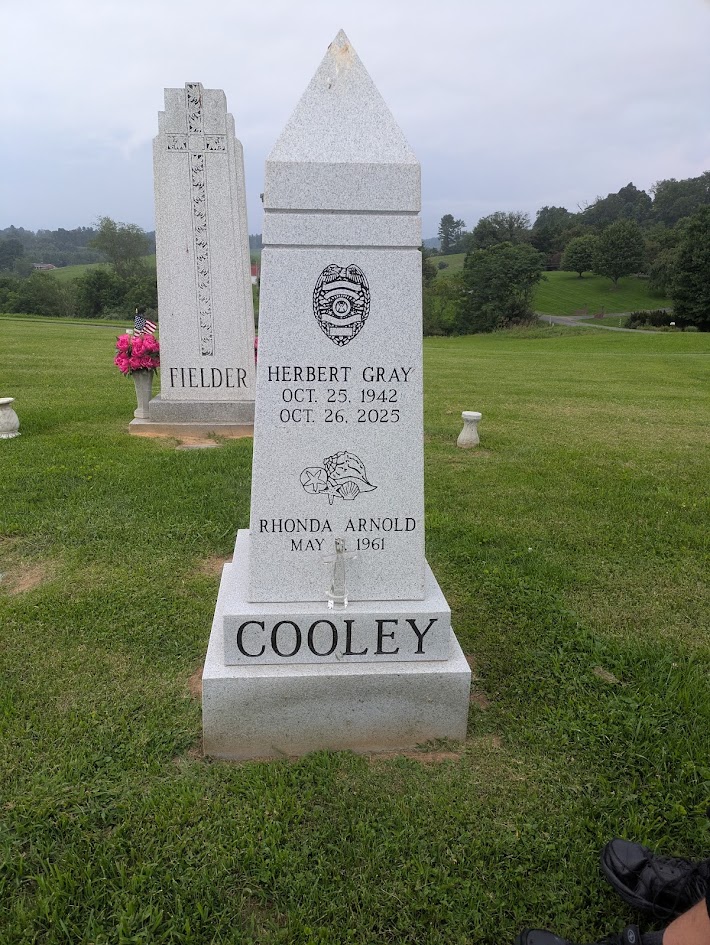
My father, Herbert Gray Cooley, was born in rural Grayson County on October 25, 1942. He graduated from Galax High School and went on to earn a bachelor’s degree in Criminal Justice from Guilford College in Greensboro, North Carolina, followed by a master’s degree in Criminal Justice Administration from Virginia Commonwealth University in Richmond. Before beginning what would become a 45-year career in law enforcement, my father served four years in the United States Coast Guard as a radio operator. In 1966, he joined the High Point Police Department, where he worked his way through the ranks as a patrol officer, traffic officer, detective, and ultimately narcotics sergeant. After eight years with the department, he joined the North Carolina Office of the Public Defender before returning to his Southwest Virginia roots in 1980 to serve as Chief Deputy of the Wythe County Sheriff’s Office. During his 14 years in Wythe County, my father helped shape much of the community we live in today. Many of the initiatives he put in place continue to make Wytheville safer—not just for residents, but for future generations, including his granddaughter Bella, who can walk its streets because of the protections he helped establish. As longtime chairman of the Transportation Safety Commission, he played a critical role in implementing traffic safety ordinances that continue to save lives. As Chief Deputy, he also launched the county’s first D.A.R.E. program, believing that prevention and education in drug resistance were just as important as enforcement. He secured numerous grants to strengthen public safety while conserving taxpayer dollars, a balance he took very seriously. He was also instrumental in bringing the 911 emergency system to Wythe County through his leadership on the Local Emergency Planning Committee. Beyond his professional duties, my father served tirelessly in numerous civic organizations, including the American Cancer Society, the Rural Retreat Lake Authority, the Ivanhoe Civic League, and the Wytheville Masonic Lodge. He chaired committees for the Chautauqua Festival through the Wythe Arts Council and organized and coached men’s and women’s softball teams throughout the county. One of the proudest moments of his career came in 1983, when he graduated from the FBI National Academy, training alongside officers from every U.S. state and 11 foreign countries. Being invited to attend the Academy is an honor; successfully completing it is an even rarer achievement. He later served as president of the Wytheville–Wythe–Bland Chamber of Commerce and a member of the American Legion. In 1994, my father left Wythe County to serve as Chief of Police in Pulaski, a position he held until 2000. He then completed the final 11 years of his career as Chief of Police for the Vinton Police Department. Under his leadership, the department achieved full state accreditation through the Virginia Department of Criminal Justice Services, becoming one of the first police departments in the Commonwealth to earn that distinction. He also served as president of the Virginia Association of Chiefs of Police. In 2011, he retired after a remarkable 45-year career in public service. As a writer, I was honored to publish Herb Cooley: The Law Enforcement Legacy of My Father, an Amazon bestselling biography released to commemorate the 50th anniversary of his entry into law enforcement. In 2024, my father was further honored with his inclusion on the Civic Monument Wall of Honor in Withers Park in Wytheville. When he passed away peacefully on October 26, 2025—one day after his 83rd birthday—I knew immediately that establishing a scholarship would be the most meaningful way to continue his legacy. I contacted Deanna Bradbury, Director of Institutional Advancement at Wytheville Community College, who helped guide me through the process of creating the scholarship. Establishing it at WCC felt especially appropriate, as my father served as a Police Science instructor there in the 1990s. Among his former students is the current Associate Professor of Criminal Justice, Jim Harrington. I am deeply honored to share that the Chief Herbert Gray Cooley Memorial Scholarship for Public Service has now been officially established. The scholarship is designed to assist students at Wytheville Community College who are studying Criminal Justice or pursuing careers in public service, including first responders. It supports students who face financial barriers that could otherwise derail their education, helping cover costs such as textbooks, tuition, and related expenses. Administered through the WCC Educational Foundation, the scholarship provides one-time, non-repayable assistance to students in good academic standing who live within the college’s service region. Award amounts may vary, but the mission remains constant: to keep good people moving forward. This scholarship is a fitting tribute to a man who spent his life opening doors and saving countless lives. I am profoundly grateful to the donors who made this vision a reality: Chief Debra Duncan of the High Point University Campus Police; retired Captain Steve Campbell of the High Point Police Department; Carl and Kimberly Ayers; Bill and Faron Smith; and Kathryn Knack Hagwood, Attorney at Law, PC. Without their generosity, this scholarship would not exist. I am also deeply thankful to Deanna Bradberry and Dr. Dean Sprinkle, President of Wytheville Community College, for helping make the scholarship official. Continued support will be essential to sustain the fund and help students year after year. Through this effort, my mission is simple: to ensure that the sacrifices and service of Herbert Gray Cooley—to this community and many others—are never forgotten.  

Strictly Observing

‘Alice’ brings Barter magic to Wytheville

‘Alice’ brings Barter magic to Wytheville

It was such a genuine thrill to see the Barter Players on stage again—especially here in my hometown at our beautiful Millwald Theatre on Friday, February 13. Their gorgeously whimsical and vibrantly colorful production of Alice in Wonderland was nothing short of magical. In just 45 minutes, the six Barter Player actors had more than 300 audience members—predominantly children who attended the show for free—utterly spellbound from beginning to end. The performance was made free to local public-school children thanks to the generous sponsorship of the Wythe Bland Foundation, whose support ensured that so many young people could experience live theatre at no cost. What a gift to this community. One can rest assured, however, that us adults were equally enthralled. For me, it was an especially meaningful evening. For over two decades, attending productions at the Barter Theatre in Abingdon has been one of the great joys of my career. Though I’m no longer able to travel back and forth regularly, this touring production felt like a rare and cherished homecoming. The ensemble of half a dozen brilliant actors—each a true triple threat of singer, actor, and dancer—brought boundless energy to this wacky and wondrous adaptation of the original work by Lewis Carroll. The book and lyrics were written by longtime in-house Barter playwright Catherine Bush, with music by Dax Dupuy. Together, they crafted a script that remained loyal to Carroll’s riddling verse while infusing it with fresh theatrical vitality. Jay Ruttenberg took center stage as Alice, adorably embracing the precocious character with equal parts curiosity, determination, and a healthy distaste for rules and the mundane. Stephen Cradic was my personal favorite of the evening, portraying the flamboyant King of Hearts as well as the satirical Caterpillar. His tremendous humor and discernible upbeat energy illuminated the stage with immense enjoyment. Whether grooving to a psychedelic ’60s beat before Alice takes a bite of the mushroom or swaying to elevator music as she plummets down the rabbit hole, he added lightheartedness and laughter to every scene in which he appeared. Tyler Cramer, a longtime favorite Barter Player of mine, flawlessly performed the roles of the White Rabbit, the Mushroom, Alice’s Uncle Charles, and several others with his trademark humor, confident singing, and crisp dancing. Marissa Emerson was a joy to watch in a myriad of roles, including Alice’s sister Lorena, the Mad Hatter, the Deuce of Spades, and more. Abigail Martin perhaps had the biggest stretch, playing Alice’s little brother Freddy, the Cheshire Cat, and several roles traditionally portrayed by men. Reilly Blevins was equally brilliant in her maternal portrayals—Alice’s mother, the Queen of Hearts, and the anxious Mother Pigeon who feared that a ten-foot-tall Alice might be after her unhatched eggs. The dialogue in this adaptation was particularly impressive. We were given deeper glimpses into Carroll’s original text than many of us are accustomed to from the familiar Alice in Wonderland. The set design was drenched in brilliant pinks and purples, anchored by a Roman numeral clock spinning seemingly out of control in the background. And in this telling, Alice does not simply chase the White Rabbit out of curiosity—she ventures into Wonderland to retrieve a blank book her sister has given her to fill with her adventures. Clever references to both Alice’s Adventures in Wonderland and Through the Looking-Glass appeared throughout, including a nod to the character of Time during the Mad Hatter’s tea party scene. The blur between fantasy and reality is executed clearly here as well as morals of moderation, appreciation, and autonomy. All are clearly conveyed in his one-of-a-kind production. The implementation of characters from Alice’s real-life into her imagined one via fantastical alter-egos, as done with Dorothy for The Wizard of Oz, was also a key component to the plot of this production. Just as I was enchanted when I first saw a Barter Theatre production of The Emperor’s New Clothes as a seven-year-old first grader, I remain captivated by the quality and imagination of every Barter production I encounter. Theatre has been a major part of my life as a columnist, and Barter has been central to that journey. It is my fervent hope that future touring productions from Barter Theatre will continue to return to Wytheville. Live theatre—especially when made accessible to children—has the power to ignite imaginations and create lifelong memories. On this particular February evening, it did exactly that.  

Strictly Observing