Zach Cooley

Month: August 2026

Newberry delivers full original set in Wytheville concert
Newberry delivers full original set in Wytheville concert

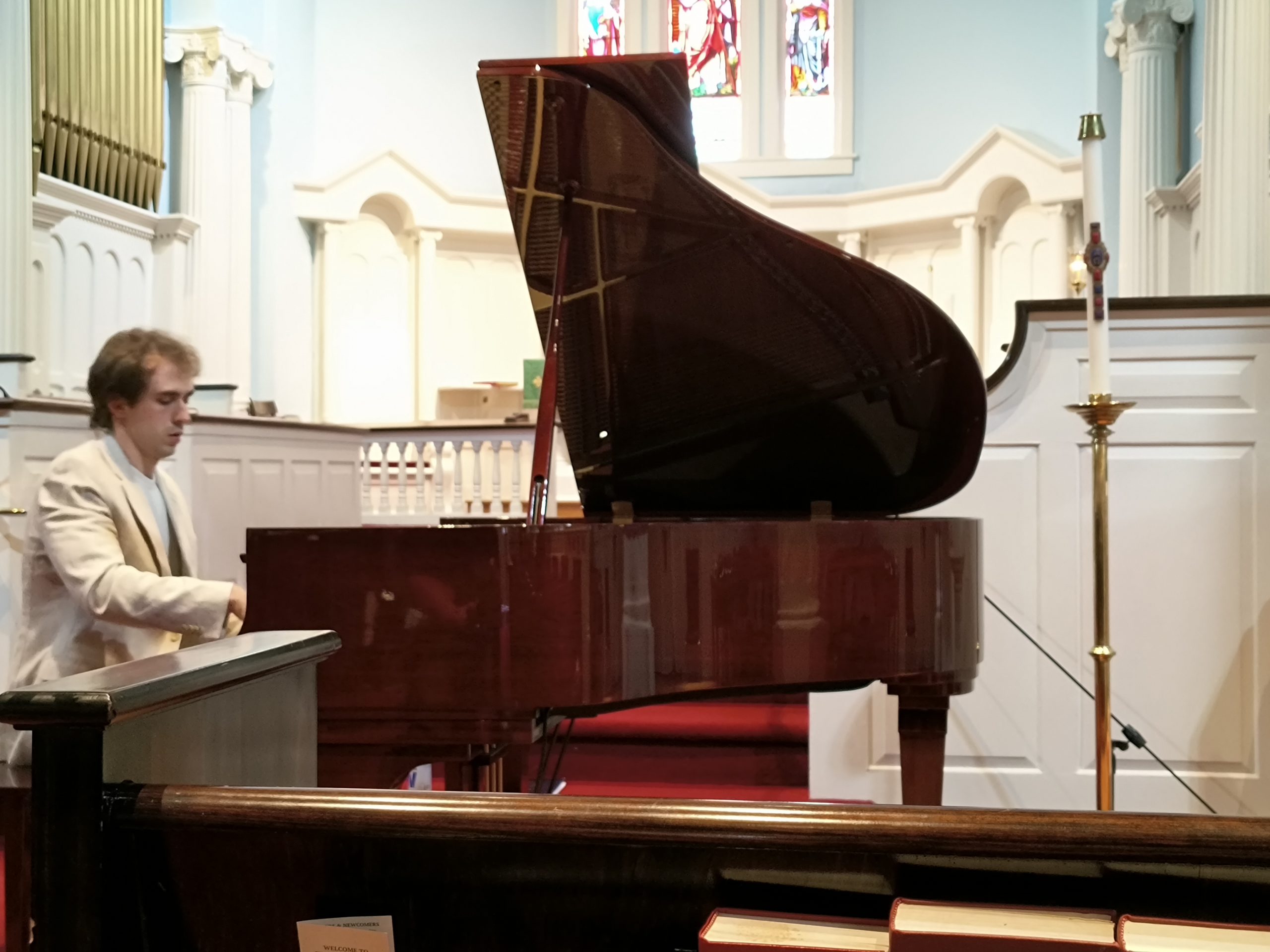
It is hard for me to believe Albert Newberry did not come out of the womb playing the piano. There is only one way I can sum up his playing: If he is able to achieve with his future bride what he accomplishes on a piano during any given concert, he is destined for an inevitably rapturous wedding night. Every muscle in his body seems to work in concert to ensure that the exact note he intends emanates from his grand piano. Somehow, it happens without fail every time. The Bland County native divides his time between his Southwest Virginia home and New York, where he teaches piano and plays gigs whenever possible. It was my honor to see this virtuoso of the ivories live in concert at St. Paul Episcopal Church in Wytheville on Sunday, Aug. 9. This was the best performance I have ever seen from Newberry, as a fortunate audience of only a couple dozen people were treated to 21 original compositions that will eventually be released across two albums. “We recorded so much music that we had to split it up into two albums,” he explained. “I have not timed the entirety of the songs all together, so if they end up being too long, I may cut some for the record.” I pray he does not make that decision, because the full expressions of all these compositions would be the ultimate gift to anyone who appreciates exceptional piano music. In an 80-minute concert that flew by as though it lasted only five minutes, Newberry gave us a glimpse into his incredible musical genius. He opened with two original compositions, “Pastorale” and “Toccata,” numbers that were filmed in that same beautiful church for PBS Appalachia. The film went on to win an Emmy Award. Newberry’s playing has an uncanny ability to heighten the imagination. During one number, you could envision a Charlie Chaplin film unfolding before your eyes; during another, a Looney Tunes cartoon came to mind; and still another seemed perfectly suited for a Steve McQueen chase sequence. To observe Albert Newberry at the keys, one might almost believe he has more than two hands playing his own compositions. Watching his hands cross over one another and his arms contort into seemingly impossible positions to execute these genius sounds is jaw-dropping, to say the least. Newberry has also experienced a great deal of personal loss during the past year. He lost a friend in Blacksburg whom he considered one of the greatest appreciators of music he had ever known. “This man was not a musician,” Newberry explained. “But he had a separate room in which he did nothing but listen to records. Most of us have music playing in the background, but he kept a room where he could just simply listen to the music.” For his friend, Larsen Bowker, Newberry dedicated his song “Home.” He also lost his Russian grandmother during the past year and dedicated another beautiful piece to her, entitled “Autumn.” Those were probably the most resonant pieces for me personally during the evening. Having lost my own father around the same time Newberry’s grandmother passed away, I felt those songs deeply, perhaps in a way that allowed me to understand something of what he must have felt while writing them. There were also several groups of compositions, including the six-part “Rhythmic Studies,” the four-part “Disparate Elements” and the three-part “Perpetuum Mobile.” Another of the evening’s more moving pieces was “Piece for Peace,” inspired by the many friends Newberry has in both Ukraine and Russia. “I wrote this when the war involving Russia and Ukraine broke out,” he said. “As the son of a Russian mother, my family and I have many friends and relatives who are affected by this war.” Newberry possesses a quintessential ability to create more emotion with a series of notes than many composers can achieve with lyrics. His music engages the senses and evokes vivid images within the listener’s mind. His talent is unparalleled, and we in Southwest Virginia are fortunate to call a person of his genius, and an equally heartfelt human being, one of our own. As much as I enjoyed his performance last Christmas with guitarist Casey Lewis, I enjoyed this solo performance even more because it allowed me to witness, without distraction, the magic Newberry creates through his own compositions. It was an evening that demonstrated not only his extraordinary technical ability but also the emotional depth and imagination that separate a gifted pianist from a true artist. Both of the albums are produced by Bartosz Lasecki, a composer based in New York. It was recorded in July at Echo Park Studios in Bloomington, Indiana with engineer and owner, Andy Beargie. I will await the release of both albums with bated breath, and I am anxious to see what other incredible work Albert Newberry will produce in what appears destined to be an extraordinarily bright future.
Uncategorized

Byrd remembrance brings ‘tears from God’

Byrd remembrance brings ‘tears from God’

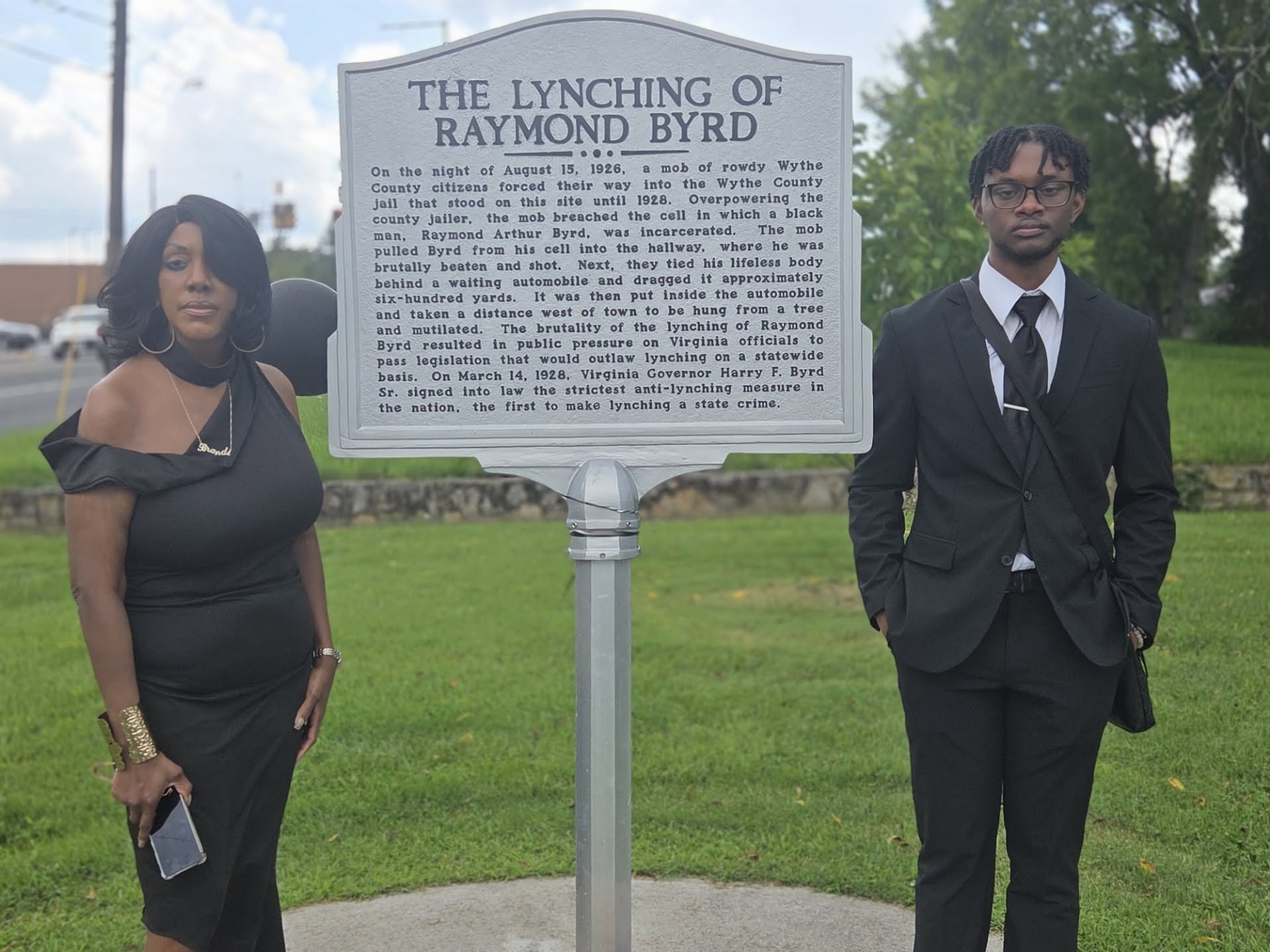
Patricia Austin called the torrential downpour that fell on downtown Wytheville as approximately fifty of us gathered to commemorate the centennial anniversary of one of the darkest chapters in our local history “tears from God.” One hundred years earlier, on Aug. 15, 1926, a 31-year-old Black man named Raymond Arthur Byrd was attacked, beaten, shot and lynched by an angry mob of white men from Wythe County. Byrd had been accused of a sexually assaulting a white girl, after which a group of racists took matters into their own hands and committed the unspeakable act of violence. Today, a historical marker commemorating Mr. Byrd’s life and legacy stands in front of the site of the old Wythe County Jail, where he was held before being taken by the mob. “We stand here not only to remember the injustice, but to confront the truth of what happened,” said Austin, executive director of the Wytheville Training School and Cultural Center. “This ceremony is an act of courage, an act of community responsibility, and it is an act of love for justice and a love for the future that we are building together.” The lynching of Raymond Byrd sparked statewide and national outrage and left generations of his family to live with the trauma of a failed justice system. Standing beside the marker, Byrd’s great-granddaughter, Brandi Quinn, wept as the tragedy that had been carried through generations of her family, was recounted. Her son, Raymond Byrd’s great-great-grandson Braylin, read a poem written by Byrd’s widow sometime after her husband’s horrific death. Overcome by emotion, he, too, shed tears. Braylin is currently attending college in Ohio going into his Junior year as a Political Science Major and Communications Minor. He was also elected Senator at Large on his campus. Raymond Byrd’s widow, Tennessee Hawkins Byrd Patterson, lived only 15 years longer than her husband, dying of malignant hypertension at the age of 39 in 1941. According to research presented during the ceremony, she had been refused medical treatment by white doctors in Wythe County. Dr. Thomas Edge, teaching professor of ethnic studies at Bowling Green State University, presented extensive research on Raymond Arthur Byrd, his tragic death, its effect upon his family and community, and the continuing search for acknowledgment and truth. A feature-length documentary on the story is also being planned. “My goal is not simply to recount the horror of what happened,” Dr. Edge said. “My goal is to continue the legacy of the family and to note how they coped with the trauma of such a horrible ending to their ancestor’s life.” One of the most emotional portions of the presentation focused on Hazel Byrd Hayes, the daughter of Raymond and Tennessee Byrd. In an effort to help her family, Hazel reportedly lied about her age to join one of the first female military units during World War II in order to send money home to help her siblings. Following her military service, she joined the Great Migration north and eventually built a successful career as a beautician in Ohio. “She not only had to deal with the tragedy of her father’s death, but also her mother,” Dr. Edge pointed out. “The fact that her mother died at an extremely young age after being refused medical treatment by white racists was equally traumatizing for the young woman.” It was not until a decade after Raymond Byrd was killed that his widow could apply for a military headstone for him. In 1936, the law was changed to allow qualifying military veterans to receive a government-issued headstone. Before then, victims of racial violence were often buried in unmarked graves. Brandi Quinn is the only grandchild of Hazel Byrd Hayes, who often shared with her granddaughter both the beauty of Virginia and the pain of living in a community that constantly reminded her of the father she lost when she was only 2 years old. “My grandmother shared with me so many things about the beauty of Virginia,” Quinn said. “But she also shared with me the difficulty of living in a community that constantly reminded her of the loss of her father.” A World War II veteran, Hazel Byrd Hayes moved north to Toledo, Ohio, where her family continued to grow and thrive. Today, her granddaughter and great-grandchildren carry on that legacy. Her great-grandson bears an uncanny resemblance to his great-great-grandfather, and it was a privilege to be introduced to this family. They approached the commemoration of an unspeakable family tragedy with tremendous grace and class and it was a singular honor to meet them. “Thank you for greeting us with warmth and love,” Brandi Quinn said. “We will carry you in our hearts back to Toledo with us.” Being part of such a ceremony is something my wife Emily and I will never forget. Despite the horrors of racism that still exist today in this community, there was something profoundly moving about witnessing such an outpouring of humanity. People stood together in the pouring rain, united by the belief that the truth matters and that the life of Raymond Arthur Byrd matters. May his soul rest more peacefully in the knowledge that there are those who will not forget his life, his struggles or the injustice inflicted upon him. May we never forget the plight of any human being who is treated as though they are somehow less worthy than another. And may the truth of Raymond Arthur Byrd’s story, and stories like his, never be lost on those who continue striving to make humankind better through the way they choose to live their own lives. Remembering is not enough if it changes nothing. It is where the responsibility begins.

Zach's At It Again

Antoniou provides mind-bending entertainment at Millwald

Antoniou provides mind-bending entertainment at Millwald

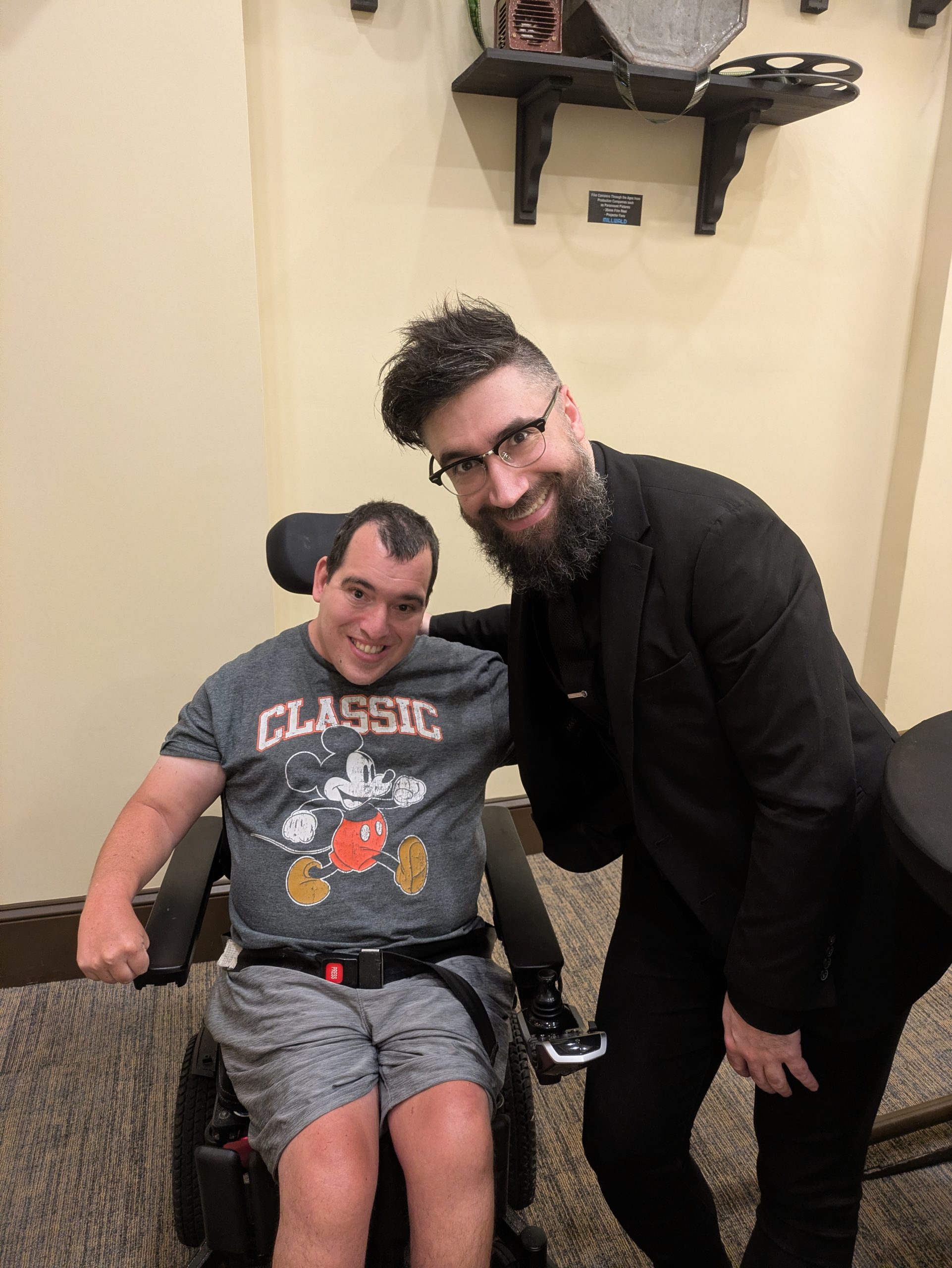
British psychic comedian Peter Antoniou returned to Wytheville for his second sold-out performance at the Millwald Theatre on Saturday, August 8th, and this time I was fortunate enough to be there. For 86 minutes, Antoniou had an audience of roughly 500 believers and doubters alike completely enthralled. It did not matter whether you considered yourself a believer or a skeptic. Antoniou’s ability to keep the audience engaged was undeniable. His own journey into the world of mentalism began at a remarkably young age. “I started reading tarot cards at the age of 9,” he recalled, “By 18, I was working on the 900-number psychic lines.” Eventually, his career took him to Las Vegas, following his appearance as a semifinalist on America’s Got Talent in 2021. The 38-year-old comedian and psychic has apparently never looked back. His shows have sold out around the world, and after experiencing his performance firsthand, it’s easy to understand why. I was lucky enough to become one of his participants. Early in the show, Antoniou invited audience members to become part of the performance by catching a Frisbee he threw into the crowd. My lucky moment came near the very end, when the Frisbee landed in the back row and nobody picked it up. I quickly asked my friend, Jeremy Miller, who had brought me to the show, to retrieve it and hand it to me. Antoniou asked my name. He had actually finished the personal readings, but apparently decided that my mental intuition was too strong to ignore. “Are you thinking of starting a podcast?” he asked. The truth was that I already had one. The question I had submitted for him to hopefully answer was whether I should revamp the podcast and, if I did, whether it would be successful. “You’re worried about whether or not it will be successful,” he told me, “but you don’t have a clear definition of success.” That wasn’t entirely true. To me, success would mean waking up one day to discover that I had enough listeners to monetize the program and, in a dream scenario, eventually be relieved of the essential need for government assistance. “I can hear you thinking,” he said. “I know you’re doing this, but answer me about my podcast.” He was definitely right about that. “I think a podcast is a wonderful idea for you,” he continued, “but you need to let go of the stress of trying to make it successful and just make it as fun for you as you possibly can. Whatever is fun for you, that’s what the podcast should be.” “You’re a very loud thinker, Zach,” Antoniou told me. “I can appreciate that, but it’s very distracting.” In reality, I was simply doing what he had told all of us to do at the beginning of the show. “The louder you scream at me in your head,” he had said during his opening remarks, “the greater chance you have of being heard during the program.” After asking me the year of my birth and a second participant an important year in her life, he then asked the other Frisbee holder for seven random numbers. The remainder of the crowd was instructed to perform calculations on their phones. The numbers began with 1,985 multiplied by 1,981. That result was then added to 2,675,319, and 74,219,305, a number punched into a calculator by another participant who had been brought onstage without looking at the keyboard. The final total was exactly 80,826,909. Those numbers represented the exact date and time at that moment: August 8, 2026, at 9:09 p.m. But my experience was only one of many memorable moments throughout the evening. My longtime friend Bonnie Asbury was also singled out by Antoniou. Her story wasn’t discovered as the answer to a question. Instead, it became an inspiration, which it most certainly is. After a lifetime of heartbreak, Bonnie recently found the love of her life after searching for more than 30 years to find him. Her husband is a 40-year veteran of the National Guard, and together they have written a story that serves as a reminder that love can be found at any age and under any circumstances. No one deserves that happiness more than Bonnie, and I couldn’t be happier for her. Antoniou’s readings took several unexpected turns throughout the evening. At one point, he suddenly described a bizarre vision of Kermit the Frog riding a swan while being struck by lightning. It turned out to have a very real connection to a gentleman sitting on the opposite side of the theater. Kermit Swan had reportedly been struck by lightning twice and electrocuted a number of other times. “You want me to tell you whether or not you’re going to get superpowers,” Antoniou said. “You are not going to get superpowers, but you might develop a twitch.” He then jokingly, but emphatically, asked Kermit to promise that he would stay away from electrical outlets and other dangerous ways of harming himself. Kermit reluctantly agreed. One gentleman wanted advice concerning his cat, which had apparently, through a pet psychic, relayed some very strong opinions about a particular aspect of its owner’s housekeeping. Antoniou didn’t reveal the secret, but he did tell the cat’s owner that he definitely needed to take his pet’s advice. There are very few acts these days that I would willingly pay to see. Peter Antoniou is certainly one of them. Between the laughter, the unbelievable demonstrations, the personal readings and the unexpected moments of genuine inspiration, he gave me an evening I will never forget.

Strictly Observing

Memorializing my father at ancestorial reunion

Memorializing my father at ancestorial reunion

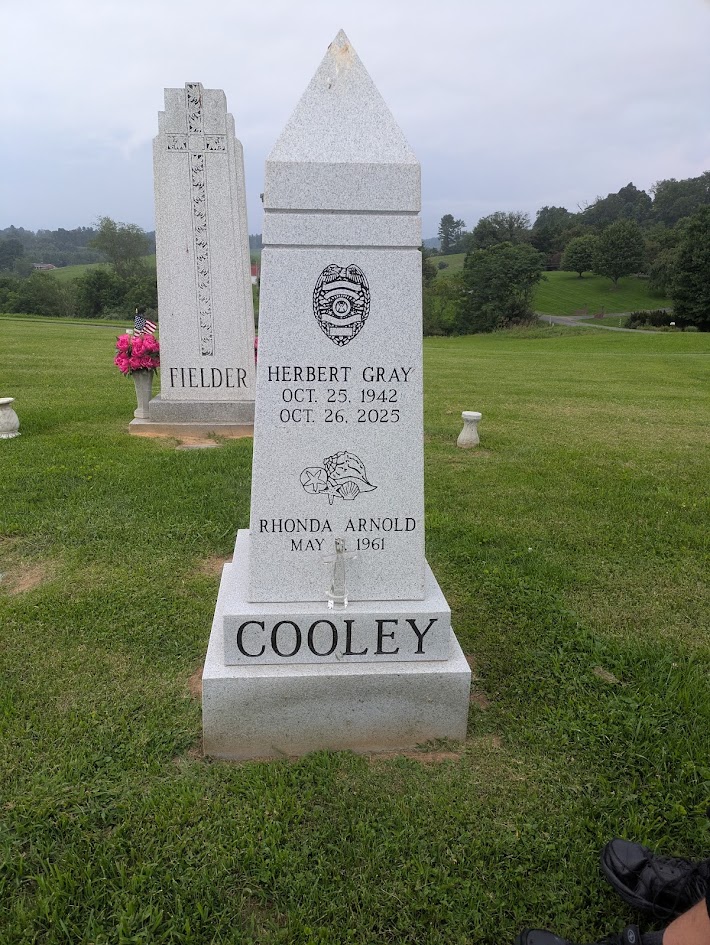
On August 1, generations of William Rufus Cooley’s descendants gathered at Coal Creek Memorial Park for their annual reunion. I am actually a descendant of William’s brother, Wiley Preston Cooley, who was my great-great-grandfather. My father was one of three people memorialized at the event, which prompted me to attend. My dad had been to these reunions several times, and I was both saddened and honored to speak about him to his many distant relatives. I was so thankful to be aware of this year’s reunion, thanks to the Cooley Family Facebook page maintained by Becky Helton. There was no one there who truly knew my father, and I couldn’t bear the thought of him not being remembered at an event that meant so much to him. I wasn’t sure what memorial items to bring, so I brought a copy of my book, Herb Cooley: The Law Enforcement Legacy of My Father, for display. As I was enjoying the meal following the service, a cousin named Luke approached me, asking if my dad had served on the board of directors at the Cardinal Criminal Justice Academy in Salem. When I said he had, Luke told me he was currently going through that very academy. I knew then that Luke was the person for whom my book was meant. I signed it for him, and the money he gave me went to the cemetery fund in Dad’s memory. Dad would have been so happy that a fine young man like Luke was continuing the Cooley law enforcement tradition while honoring his legacy. Afterward, I went to spend some time at Dad’s resting place. My parents have the nicest monument in the cemetery. Even though I know Dad wasn’t truly beneath the ground at my feet, I found myself unable to break away from the spot. I felt so empty. Still, my dad deserved to be remembered that day; it’s what he would have wanted. I feel blessed that, despite my limitations, I was able to pay him a tribute I hope did him justice. My father loved the Cooley reunions. He especially loved the memorial services held in honor of our loved ones who had passed away, which is why I wanted to ensure I didn’t miss the opportunity to pay homage to his memory. My father was one of the most decorated police officers in the Commonwealth of Virginia. His lifetime of service began with a four-year stint in the United States Coast Guard, where he served as a radio operator from 1962 to 1966. He was immensely proud to have served his country, but I would go so far as to say he was even prouder of his heritage as a Cooley—not just as a Cooley, but as a Coal Creek Cooley. He loved the area where he grew up and never stopped reminiscing about the blissful days spent on his Grayson County farm, the place that represented his childhood. During the last dozen or so years of his life, he became an incessant genealogical researcher. If he could have traced our ancestry all the way back to Adam, I’m fairly certain he would have done so given enough time on Earth. He knew the stories of our ancestors as well as anyone ever could, and he delighted in sharing them. He was especially proud that Abraham Cooley, our first ancestor to settle in Grayson County before the dawn of this nation, was a signer of the New York Declaration—one of the documents that helped pave the way for our eventual Declaration of Independence. It seems almost serendipitous that his son, Benjamin Cooley, would later become the first elected Sheriff of Carroll County, Virginia. That passion for public service clearly still runs through our veins today. In addition to my father’s remarkable 45-year career in law enforcement, he now has a great-grandson who has graduated with a degree in Criminal Justice from Dad’s alma mater, Virginia Commonwealth University in Richmond. I know that would have made him profoundly proud, as did his ancestors’ military service, which encompassed every generation right down to his own. The last time I was in the Coal Creek Community Church on November 8, 2025, I was eulogizing my father before a capacity crowd of more than 150 police officers, family members, and friends who mourned him then and continue to miss him today, just as I do. “I can still vividly recall our many trips to the cemetery here, where he would regale me with stories of our great-grandfathers from generations past,” I said. “Today, I will visit that cemetery for the first time since his funeral to pay my respects to him in the place where he always wanted to rest. One day, my wife and I will rest beside him.” “If he were here today, he would be greeting each of you with his trademark million-kilowatt smile, trading stories about the famous Benjamin Cooley clock, which he and I, along with my wife and daughter, were fortunate enough to be photographed with at the Carroll County Museum,” I concluded. “Those memories fill me with joy today, just as they always do whenever I remember what a great man my father was and the great stock from which he came.” The Cooley blood that flows through our veins is the blood of honest, hardworking people who believed in family, as well as the privilege and responsibility of being Americans. As we gathered in fellowship on that day, I did so with the comfort of knowing that my father had been proudly honored, just like all of our loved ones who have gone on to Heaven before us. Until we are reunited with them again, we should never forget what Coal Creek, Grayson County, and Carroll County mean to our heritage. My father certainly never did. And thanks to him, neither will I.  

Strictly Observing