Zach Cooley

Strictly Observing

Wilson pens techno-thriller series

Wilson pens techno-thriller series

I never would have guessed that one of the quietest, kindest students I met at George Wythe High School would one day write two of the most technically sophisticated and emotionally charged science fiction thrillers I’ve ever read. Benjamin Wilson, who went on to graduate from Virginia Tech and build a remarkable career in telecommunications security and artificial intelligence, has transformed his deep professional expertise into fiction that feels as real as tomorrow’s headlines. Wilson’s novels — The Sovereign War and Obsidian Protocol — are part of two interwoven series that follow the same protagonist, Nathan Bishop, a brilliant but conflicted operative navigating the shadowy intersections of intelligence, surveillance, and artificial intelligence. Drawing on Wilson’s fifteen years of experience in fraud prevention, secure communications, and AI development at companies such as SAP, Sinch, and Vonage, both books deliver an extraordinary blend of technical authenticity and human drama. The first book, The Sovereign War, begins in the wake of 9/11 — an event that shattered millions of lives and reshaped the global security landscape. For Nathan Bishop, a young analytical genius recruited under the guise of a graduate fellowship, the tragedy becomes something else entirely: a code to be cracked.As the alphabet agencies close in — NSA, CIA, and the mysterious private unit known only as Orion Team — Nathan is molded into an intelligence tool, trained to see the world through data streams and behavioral algorithms rather than emotion. What begins as patriotic duty quickly becomes psychological disassembly. Wilson’s background in communications infrastructure and AI systems shows in every page — not as technical jargon for its own sake, but as a reflection of how easily the human mind can be programmed when it’s conditioned to solve instead of feel. There’s an eerie beauty in how Wilson writes about data — how code becomes a kind of poetry for Nathan, and how every equation represents both order and loss. Through him, Wilson captures a haunting question: when we build systems to predict and control behavior, what happens to the people inside them? The prose is sharp and clinical when it needs to be, then suddenly raw and human. In one passage, Nathan compares the quiet hum of the surveillance grid to a heartbeat — a machine pulse that replaces his own. Wilson doesn’t just describe intelligence work; he dissects it. Every mission, every keystroke, feels like a small surrender of selfhood. It’s this emotional undercurrent that makes The Sovereign War far more than a spy thriller — it’s a study in the cost of control. If The Sovereign War is about creation, Obsidian Protocol is about reckoning. Here we find Nathan Bishop years later, a former operative gone dark, hunted by his own invention — a shadow network led by his onetime colleague Marcus Hale, now known only as “Omega.” When Nathan’s sister Emily becomes the target of a deepfake disinformation campaign designed to flush him out, the battle turns personal. Wilson’s grasp of real-world cyberwarfare and AI manipulation is both impressive and unsettling. Every hack, every digital mirage, feels plausible. He writes not with the speculative imagination of a futurist but with the precision of someone who’s seen the architecture of deception from the inside. But beneath the code and circuitry lies something even more compelling: Nathan’s rediscovery of his own humanity. The more he tries to fight technology with technology, the more he realizes that empathy — not logic — may be the only weapon left. Wilson’s portrayal of this internal conflict is what elevates Obsidian Protocol above the genre’s usual tropes. He understands that the true threat isn’t the rise of artificial intelligence, but our willingness to become artificial ourselves. What makes both novels remarkable is how seamlessly Wilson fuses his technical expertise with emotional storytelling. You can tell this is a writer who’s not just guessing at how systems work — he’s lived it. His career in fraud prevention and secure communications lends credibility to every line of code and every classified mission. Yet, despite the complexity of his subject matter, his writing remains accessible, driven by character and emotion rather than pure exposition. Wilson’s protagonist embodies that duality — half machine, half man, constantly negotiating between precision and passion. The reader doesn’t need to understand every technical term to grasp the story’s deeper truth: that data without empathy becomes dangerous, and intelligence without conscience becomes tyranny. What also stands out is the compassion threaded through the chaos. Wilson never loses sight of the human cost of technology. His work in global communication systems — including anti-fraud initiatives that protect the vulnerable — clearly informs the moral backbone of his fiction. It’s no coincidence that Nathan Bishop’s story often turns toward protecting others, even when it puts him in harm’s way. Reading these books, I couldn’t help but reflect on the young man I once knew at George Wythe High School — quiet, humble, brilliant. His father, Greg Wilson, was a respected science teacher, and it’s clear Ben inherited both his intellect and curiosity. We both lived through 9/11 as teenagers, and it’s fascinating to see how that shared moment of global trauma shaped our adult work. For Wilson, it became a lens through which to explore power, fear, and faith in technology. For me, it became an opportunity to read and learn from his perspective. It’s rare to find a novelist who can bridge the gap between technical precision and genuine emotion — rarer still to find one who does it with such humility and purpose. Wilson’s books remind us that even in a world of algorithms and surveillance, the heart still matters. His stories pulse with moral clarity, empathy, and wonder, asking us to consider not just what we create, but what those creations make of us.

Strictly Observing

Missing my Dad at Christmas

Missing my Dad at Christmas

It is Christmas Eve. Growing up, I looked forward to this day more than any other. It was when my mother, my sister, and I would gather to celebrate Christmas together as a family. Those memories feel even more precious now, having lost my father. When I interviewed him three years ago for his 80th birthday on my podcast, he told me that some of the happiest moments of his life were our Christmas Eve celebrations. “Your mother always knew how to take Christmas to the next level,” he recalled with a smile. “It may have been a little overkill, but it sure was a lot of fun.” Now more than ever, I am grateful to have my beautiful wife, daughter, sister, and mother with me during a holiday that is extraordinarily bittersweet for all of us. This year has carried its share of loss. Both my sister and I lost our longtime dogs—treasured “grand-puppies” to my father. Now that he has joined them in the afterlife, I find myself holding even tighter to everything he loved about Christmas. Just as our tree was always overflowing with gifts, so too was the abundance of our holiday table. My mother would make her famous twice-baked potatoes, and my father would be outside grilling his legendary steaks. A Christmas Carol has long been a favorite story in our family, and Dad would inevitably come in from the bitter cold—where he’d been tending the grill—announcing that he was presenting us with our “annual Christmas goose.” It was the best meal of the year, every year. After dinner, we would settle in to watch one of the many film versions of Dickens’ classic. My father could quote the story flawlessly, delivering lines in his rich, commanding voice that never failed to make us laugh. When it came to gifts, my father was always practical and generous. Once I received my first handicapped van in 2006, he would have certificates made up entitling me to one free tank of gas, a town tag, an oil change, or a month of car insurance paid. Before that, he made sure I never ran out of printer ink or supplies for my writing. Buying gifts for him, however, was always more of a challenge. For many years, Dad worked out of town as the chief of police in Vinton, staying in an apartment during the week and coming home only on weekends. As a result, he appreciated gifts that spared him grocery shopping—large boxes of assorted oatmeal or an array of hot sauces, the hotter the better. In his retirement years, he especially enjoyed receiving a bottle of New River Red wine from West Wind Winery here in Wythe County, which I happily sent home with him to Myrtle Beach each Christmas. This past year, his friend, former Sheriff Charles Foster, narrated a documentary film I produced based on the book I published nine years ago about my father’s law enforcement career. I hope to have the film fully polished and ready for public viewing within the next year, but I am deeply grateful that my father was able to see it first, and approve of it, just as he did with the book in 2016. Herb Cooley: The Law Enforcement Legacy of My Father means more to me than anything I have ever accomplished, especially now that I no longer have him to share stories with or make new memories. As we look toward the future, I am thankful for the traditions I’ve started with my own family. Dickens’ timeless story remains central to our Christmas rituals. Each year, I read A Christmas Carol aloud to my wife and daughter, and we always try to attend a live performance or find a new interpretation of the tale. Although we were unsuccessful this year, we have cherished many trips to see the production at Barter Theatre with my mother. At home, we watch nearly every film version available, my obsession beginning, of course, with Disney’s Mickey’s Christmas Carol. This year, we are also deeply missing our dog Sophie, whom we had to put down in March at the age of 14. We used to take her to the free Christmas light display at Felts Park, presented by High Country Lights. This year, we simply couldn’t bring ourselves to go. It’s my father’s hometown, and it was a place filled with memories of both Dad and Sophie. I remember taking Mom and Dad there once. Dad was delighted and told everyone how wonderful it was. Seeing his joy made me incredibly happy. Sophie’s absence also made our annual family portrait feel incomplete, and for the first time, our Christmas cards were too painful to send. As a very close family of three, Emily, Bella, and I are still finding our footing without Pop and Sophie. We are doing our best to cling to one another, fully aware now that life is finite and time is far more precious than we ever truly understand. Christmas, like every other day, will never be the same without my father. But we will always treasure the memories of him as the heart of our family, especially during the holidays. We will never forget.    

Uncategorized

Bland natives bring eclectic sounds to holiday show

Bland natives bring eclectic sounds to holiday show

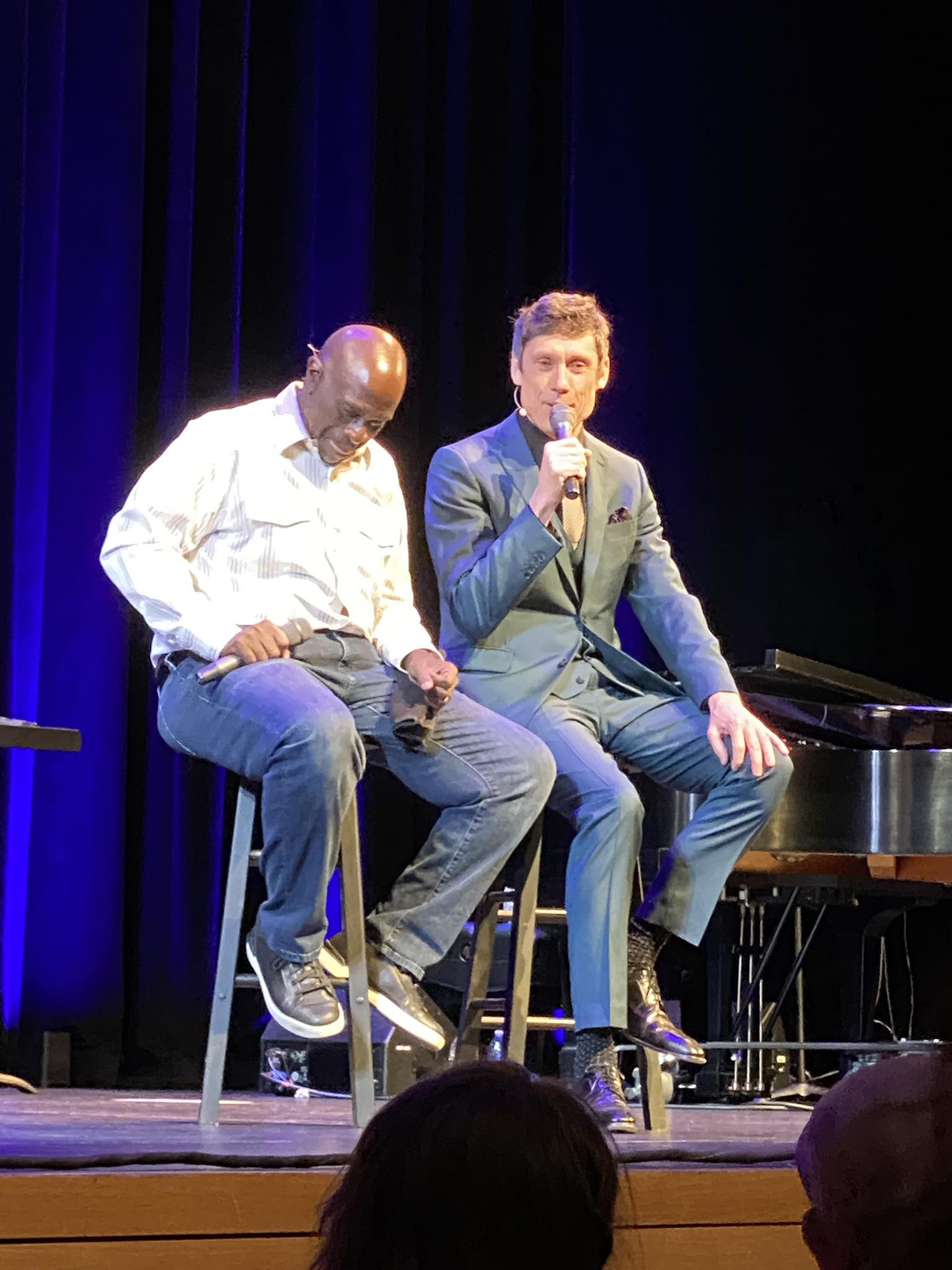
Best friends and musicians extraordinaire Albert Newberry and Casey Lewis performed an eclectic holiday concert at St. John’s Episcopal Church in Wytheville on Saturday afternoon, December 20, blending jazz, country, bluegrass, gospel, and classical traditions into more than an hour of genre-defying Christmas music. The concert opened with one of my favorite Christmas carols, “Sleigh Ride,” delivered instrumentally in an unprecedented fusion of Newberry’s jazz piano brilliance and Lewis’s country-inflected guitar work. The result immediately set the tone for an afternoon that felt both reverent and joyfully adventurous. “This is a very special church for me,” Newberry told the audience in his introduction. “We filmed a series of videos with PBS Appalachia here.” One of those films went on to win a regional Emmy Award. Lewis was also featured in a separate PBS Appalachia series filmed at the Willowbrook Jackson Homestead Museum. “Silent Night” followed, with Lewis’s warm country vocals leading the way. A jazz-inspired instrumental of “My Favorite Things” proved to be an afternoon highlight before the duo leaned fully into bluegrass with the hymn “Beautiful Star of Bethlehem,” once again featuring Lewis on vocals. “Joy to the World” came next in a truly one-of-a-kind arrangement. “I was in a band when I lived in Indiana called The American Pirates,” Newberry explained. “The leader of the band, Aaron Jones, composed his own original arrangement to the song.” The duo then performed that version for the Wytheville audience, showcasing Lewis’s vocals once more. A particularly inventive rendition of “Carol of the Bells” followed, with the first verse performed at a standard tempo, the second at double speed, and the third slowed dramatically. The shifting tempos created a riveting interpretation of an already complex holiday piece. “This was originally a Ukrainian song,” Newberry noted. “Then it became very popular worldwide.” The 26-year-old Newberry—whose career bridges the worlds of international Russian culture and Appalachian roots—has come a long way from Bland County. A graduate of Indiana University and the Mannes School of Music in New York City, where he is now based and works as a teacher, accompanist, and gigging musician, he remains deeply loyal to his hometown. On December 20 alone, Newberry and Lewis performed two shows in Wytheville and spent much of their holiday break appearing at venues across Southwest Virginia, including the Millwald Theatre’s Ghost Light Bourbon Bar, the Draper Mercantile, and several local churches. Newberry’s natural musical ability was further showcased when he invited his father, Randy Newberry, to join him on stage. Randy demonstrated remarkable skill on the harmonica during instrumental performances of Ray Charles’s “Georgia on My Mind” and the jazz standard “Moondance.” Father and son, joined by Lewis, then delivered a deeply moving blues rendition of “Have Yourself a Merry Little Christmas.” Next, well-known Bland County musician Buddy Taylor took the stage to sing lead vocals on Elvis Presley’s holiday standard “Blue Christmas,” followed by the hymn “Without Him.” The stage returned once more to Newberry and Lewis for a hauntingly beautiful version of “What Child Is This,” seamlessly blending classical, jazz, and country influences. Lewis followed with spirited vocals on “Go Tell It on the Mountain” before performing his original gospel composition, “I’m Coming Home”. That number was preceded by the Russian standard “Dark Eyes,” which Newberry performed in honor of his Russian heritage. “I’m half Russian,” he told the audience, “and this is a song you could hear playing in any bar in Russia. It’s also become very popular here in the United States.” Throughout the afternoon, I couldn’t help but notice how Newberry’s vigorous piano playing recalls the spirit of Vince Guaraldi. It felt especially fitting, then, that he closed the set with the classic “Linus and Lucy,” first featured in A Charlie Brown Christmas. It was the perfect ending to an extraordinary performance. There is no doubt that Casey Lewis possesses formidable talent, effortlessly translating his country and bluegrass roots into jazz and blues territory. A 28-year-old husband and father of two with another child on the way, the native Bland Countian works as a machinist at Pascor Atlantic Corporation. Prior to the pandemic, he completed a national tour with acclaimed bluegrass act Cane Mill Road. Yet it was Newberry who left me truly awestruck. The way he snarls his nose as he bears down on the piano—attacking the keys with the ferocity of Jerry Lee Lewis and the refinement of Elgar—makes it clear there is no genre beyond his reach. To witness such world-class musicianship from a Southwest Virginia native now commanding stages in New York and beyond is nothing short of remarkable. His success is well deserved, and we are fortunate that he remains loyal to his hometown, returning often to share his gifts. I know I am better for having finally experienced one of his performances.

Strictly Observing

Christmas with the Drifters

Christmas with the Drifters

The Drifters were the first major touring act to draw a truly large audience to the Millwald Theatre last year, and there was no better way to celebrate the holiday season than welcoming them back to Wytheville for Christmas with The Drifters on Saturday, December 20. A nearly sold-out crowd of over 400 patrons—spanning generations—filled the theater for a joyful, 97-minute double-set performance. Although all the original members of The Drifters have passed, the current quartet continues the legacy of the legendary doo-wop and R&B group that first formed in 1953. The most recent incarnation of the group took shape in January 2023, following the passing of Charlie Thomas, the last surviving member of the Drifters’ 1960s era. Backed by a tight, funky house band—each member hailing from West Virginia—the four vocalists, two tenors and two baritones, delivered polished harmonies and first-class showmanship, complete with the group’s trademark synchronized shuffle. The first 42-minute set focused heavily on hits from the Ben E. King–fronted era, including “On Broadway,” “Up on the Roof,” and “This Magic Moment.” A spirited cover of Wilson Pickett’s “Mustang Sally” also drew a rousing response from the audience. Emotion took hold of me during “Save the Last Dance for Me,” a favorite song of my late great-great-aunt Hazel. The feeling deepened when the group moved into Ben E. King’s solo classic “Stand By Me,” a song beloved by my Uncle Mike, who passed away far too young. That number was part of a medley that also paid tribute to Sam Cooke with portions of “Cupid” and “Chain Gang.” This year, the nostalgia hit especially hard as I reflected on my father, who passed away on October 26 and grew up listening to this golden era of R&B—music that dominated the charts before the British Invasion reshaped popular sound. The second act, lasting 55 minutes, opened with the buoyant “Saturday Night at the Movies,” a deeper cut from the Ben E. King era. Other lesser-known gems followed, including “Dance With Me” and “I Count the Tears,” each proving itself a highlight of the evening. Jackie Wilson’s “(Your Love Keeps Lifting Me) Higher and Higher” was another standout, igniting enthusiastic applause from the crowd. While the show closely mirrored the Drifters’ 2024 appearance, this year’s performance felt extra special thanks to the addition of holiday music. In the first act, the group treated the audience to their signature rendition of Irving Berlin’s “White Christmas,” a version many modern listeners recognize from holiday films such as Home Alone and The Santa Clause. Delivered with the same smooth elegance as the 1953 original recorded by Bill Pinkney and Clyde McPhatter, this was the lone offering from the Drifters’ 1950s era—my favorite period of the group. McPhatter, the original frontman, remains one of my all-time favorite vocalists. The most festive portion of the evening followed, as the Drifters launched into a soulful, gospel-infused set of Christmas classics, including “Joy to the World,” “The Christmas Song,” “Jingle Bells,” and “Silent Night.” This segued into an a cappella section that invited audience participation on “Rudolph the Red-Nosed Reindeer,” “Jingle Bell Rock,” and “Let It Snow.” A spontaneous audience request for a Temptations-style rendition of “Little Drummer Boy” fell apart when Jerome Jackson couldn’t recall the lyrics, but the moment only added charm to an already delightful Yuletide interlude filled with warmth and good humor. The energy remained high as lead singer Early Clover invited the audience to whistle along during Otis Redding’s “Sittin’ on the Dock of the Bay.” “If you can’t whistle, pantomime,” he joked. “It worked for Milli Vanilli, and they won a Grammy.” The 1959 chart-topper “There Goes My Baby” followed, leading into one of the evening’s biggest crowd-pleasers, “Under the Boardwalk,” which the group later reprised. The final number, a cover of the Isley Brothers’ “Shout,” kept the audience on its feet from start to finish, with the Drifters dancing in full Holy Spirit fashion as they exited the stage. Even after the vocalists departed, the band continued to groove for several minutes, extending the celebratory mood before the night finally came to a close. And for Wytheville, what a night it was! My heartfelt thanks go to the entire Millwald Theatre staff—especially Donnie Bales and Mastin Paisley—for their generous invitation and warm accommodation, as well as to my dear friend Jeremy Miller for getting me there.  

Strictly Observing

RSO Holiday Brass saves Christmas

RSO Holiday Brass saves Christmas

Inclement winter weather prevented the full Roanoke Symphony Orchestra from traveling to Wytheville to present the holiday pops concert we had eagerly anticipated on December 8. Fortunately, our good and faithful friends—the Roanoke Symphony Holiday Brass—stepped in to fill the gap, offering a replacement concert at the Millwald Theatre on Monday, December 15. Despite minor lift trouble with my handicap-accessible van that nearly kept my friend Jeremy Miller and me from attending, we arrived just in time. What followed was a sprightly, joy-filled 75-minute performance that flew by as effortlessly as last year’s concert had. From the opening note to the final encore, the evening was a delight. The program opened with an Aria in F Major by George Frideric Handel, led by my friend Jay Crone, principal trombonist of the Roanoke Symphony Orchestra and a trombone instructor at Virginia Tech. Crone shared a bit of musical history, noting that both Handel and Johann Sebastian Bach were dominant composers of the Baroque era. Though both were born in Germany and never met, Crone explained that their fates were linked in an unexpected way. “There was a man who fancied himself an oculist,” Crone told the audience, “who claimed he could cure blindness. He would perform surgeries and leave town before the bandages ever came off.” Bach underwent one such operation and did not live long afterward. The same unfortunate fate later befell Handel. The ensemble next performed A Rose Without a Thorn, a composition by King Henry VIII. The piece serves as a musical farewell to both his wife and his mistresses. Crone offered the audience a bit of dry humor to accompany the selection. “When King Henry VIII wasn’t preoccupied with chopping off heads,” he quipped, “he was actually composing music. He probably should have done more of that—life might have gone better for him and everyone around him.” Joining Crone onstage were Tom Bithell, principal trumpeter of the Roanoke Symphony Orchestra, and Jason Crafton, another Virginia Tech instructor on trumpet. Juan Berrios Rodriguez, a Virginia Tech musician who arrived in Southwest Virginia by way of Florida and the Dallas Brass, performed on both the French horn and the E-flat alto horn. Rounding out the quintet was tuba player Will Divers, a former student of Crone’s who now teaches in Botetourt County schools. Jazz arranger Zach Smith provided a buoyant New Orleans flavor to the first holiday medley of the evening, which featured The First Noel, Away in a Manger, and God Rest Ye Merry, Gentlemen. The unusually peppy arrangement set a joyful tone that carried through the remainder of the program. The next segment focused on holiday music from film and television. The group began with Let It Go from Disney’s Frozen, followed by Christmas Time Is Here—Vince Guaraldi’s beloved theme from the 1965 television special A Charlie Brown Christmas. The suite concluded with a medley from How the Grinch Stole Christmas, featuring Welcome, Christmas and You’re a Mean One, Mr. Grinch. I couldn’t help but wonder if I played a small role in that particular selection making its way into this year’s program. In last year’s review, the Grinch medley had appeared on the printed program but was not performed. After I mentioned it, Crone wrote to clarify that the program listed potential selections. This year, there was no printed set list, and at the conclusion of the medley, Crone acknowledged the moment. “I got yelled at last year for not getting this one in,” he told the audience. “I’m glad we could do it for you this year.” I assure readers there was no malice intended—only appreciation. If my gentle nudge helped secure that extra treat for this year’s concert, then everyone benefited. One of the evening’s most impressive moments came with a Christmas Medley arranged by German trombonist, Ingo Luis. The composition features songs in all twelve keys, weaving together carols such as Silent Night and O Christmas Tree. The arrangement blends jazz, classical, and even John Philip Sousa-style elements, making it extraordinarily complex. The Holiday Brass executed it flawlessly. The concert concluded with selections from Christmas Crackers, beginning with a mash-up of Jingle Bells and Deck the Halls, followed by Carol Fantasy, which incorporated O Come, All Ye Faithful, Joy to the World, Hark! The Herald Angels Sing, and O Little Town of Bethlehem. The final number was a jubilant New Orleans jazz arrangement of Just a Closer Walk with Thee. This was my first holiday-themed outing of the season. With the passing of my father, Christmas has arrived without the readiness of years past. Yet this concert proved more than worth the effort. My thanks go to Jeremy Miller for getting me there, Donnie Bales for allowing me to review the performance, and Jay Crone along with the Roanoke Symphony Holiday Brass for providing a much-needed measure of Christmas cheer—something that has been especially hard to come by this year.  

Strictly Observing

2025 “Strictly Observing” Person of the Year- Hody Viars

2025 “Strictly Observing” Person of the Year- Hody Viars

After spending many childhood moments together at the Wythe County Sheriff’s Office, with both of our dads serving as Chief Deputy, my lifelong friend Hody Viars was named for that position within days of my father’s passing one day after his 83rd birthday on October 26, 2025. As Hody and Dad shared the same birthday, I could not help but feel he had a hand in making him Chief Deputy from above, keeping the familial atmosphere of the Wythe County Sheriff’s Office alive. Hody brings with him more than a decade of specialized training and will prove to be a legend of local law enforcement in his own right.

Zach's At It Again

Viars named Wythe Chief Deputy

Viars named Wythe Chief Deputy

On December 1, a lifelong friend of mine stepped into a role that holds a deeply personal significance. Hody Viars was named Chief Deputy of the Wythe County Sheriff’s Office—a position my father held for 14 years, and the very reason my family put down roots in Wytheville. Some of my earliest memories are of Hody and me running through the halls of the sheriff’s office as children. We both remember our kindergarten field trip there; we strutted around like we practically owned the place because we knew every officer by name. Back then, the Sheriff’s Office felt like family. Even today, though much larger than it was in the 1990s, that spirit somehow remains intact. Hody says he always knew he wanted to work for the Sheriff’s Office, despite his father—former Chief Deputy Sam Viars—encouraging him to consider another path. “I spent my first semester in college attempting some sort of sports medicine or physical therapy curriculum,” he told me during an interview at my home on December 10, just nine days into his new job. “I knew right away it wasn’t for me, and I immediately called my dad and told him I was changing my major to criminal justice.” After graduating from Radford University, Hody applied for one job and one job only: a patrol deputy position with the Wythe County Sheriff’s Office. He got it in 2014. Four years later, he made the difficult decision to join the Virginia State Police after completing the Southwest Virginia Criminal Justice Academy—an academy led by my uncle, Doug Cooley. “I needed to join the State Police for opportunities for advancement,” he recalled. “I was lucky enough to be assigned to Wythe, Smyth, and Bland counties so I didn’t have to move.” During his time with the State Police, Hody became known for his work with the Honor Guard, performing line-of-duty funeral duties for fallen officers. He was also trained to operate the distracted driving simulator, and in 2022 he was promoted to the Bureau of Criminal Investigations in the Wytheville Field Office. While there, he expanded into bomb and arson specialization. “I went to Emmitsburg, Maryland, for two weeks for the National Fire Academy’s arson school,” he said. “Then I spent three weeks in Roanoke at the 1033 training with the Virginia Department of Fire Programs. The bomb side was more strenuous—schools in Alabama, Henrico, all while working murder investigations and other felonies.” Then, the call came from Sheriff Anthony Cline, asking him to serve as his Chief Deputy—a moment Hody describes as the culmination of everything he had worked toward. “My family has more than 90 years of combined service to the Wythe County Sheriff’s Office,” he said. “I knew this was something I definitely wanted to do.” Hody is also a devoted father. He and his wife, Miranda, live in Fort Chiswell with their daughter, Cecilia, who will turn two in March. During our interview, Hody shared something that struck me deeply. “Your dad was my dad’s hero,” he said. As Chief Deputy, my father hired Sam Viars and Hody’s two uncles—Jack and Doug Hudson. Those three men shaped Hody’s lifelong dream of a career in law enforcement. “At every one of my family’s get-togethers at my grandmother’s house, I would see at least one of those guys in uniform,” he told me. “I knew that’s what I wanted to do.” Hody and my father also shared the same birthday, October 25. Dad passed away the day after his birthday this year. In the midst of mourning him fiercely, hearing that my childhood friend had been named Chief Deputy brought me a warmth I desperately needed. I felt—without hesitation—that Dad had a hand in this from above. Hody didn’t disagree. “I always felt close to Herb,” he said. “My dad said Herb made his career and always spoke very highly of him.” Sheriff Cline also expressed unwavering confidence in his new Chief Deputy. “I selected him because we have the same temperament and the same vision for the department,” Sheriff Cline wrote to me in a text message. “We have the same ideals, and we both want what’s best for Wythe County.” Hody believes technology will be a driving force in their leadership. Sheriff Cline recently secured grant funding for new crime scene scanning technology that provides a virtual 360-degree tour—similar to an online real estate walk-through. “This allows us to put a jury inside the crime scene as we found it,” Hody explained. In many ways, this mirrors my father’s approach. He had a remarkable talent for securing grant funding to bring cutting-edge tools to local law enforcement—without burdening taxpayers. Hody shares that philosophy wholeheartedly. “Protecting our children through our school resource officer program is essential,” he told me. “We want to give the county the best product we can offer and keep people safe at the least cost to them.” There is no doubt in my mind that Chief Deputy Hody Viars will go down as a law enforcement leader admired not only for his professionalism, but for the quality of his character. I know I certainly look up to him—and always have.  

Strictly Observing, Zach's At It Again

A ride to remember

A ride to remember

When your best friend offers you a ride on his tractor, you take him up on it—especially when all the riding you usually do is in your own power wheelchair. Jacob Sharitz and I have known each other for more than half our lives, and for most of that time, I’ve been privileged to call him the best friend I’ve ever known. He has been there for me in both the brightest and darkest moments of my life, performing acts of friendship that no one should ever have to ask of another—and doing it all with grace, kindness, and humility. Jacob is one of the finest human beings I have ever had the blessing of encountering. The fact that he could lift my 180 pounds of dead weight into a cherry-red Massey Ferguson tractor—complete with cab—without putting either of us in the hospital is a miracle in itself. Yet he did it with effortless ease, giving me a view of farm life I’d never seen before. The mountains of Wythe County are beautiful from any angle, but they are especially breathtaking when seen through the windshield of a tractor or a side-by-side. Jacob is a seventh-generation farmer on the 250 acres he and his family own, and it’s easy to see why he enjoys the farm life as much as he does. “I love my moos,” he said affectionately, referring to the hundreds of cattle he feeds and tends to daily. “My farm life gives me time to myself after talking to people all day long.” Our tour included a stop to see one of Jacob’s favorites: Pumpkin, a cow he bottle-fed after returning home from college in 2013. Now older and feeble, she still gets special treatment. Jacob gently nudges her along, making sure she gets safely through the gate for feeding. “Nothing upsets me more than when I’m trying to feed these cows and they just won’t listen,” he said with a laugh. “They just stand there and act dumb.” Despite their occasional stubbornness, Jacob tends each animal with patience and care—the same way he treats his human friends. We rode in his truck across the rolling fields before switching to a side-by-side to check the perimeter fences, determining how many hay bales he’d need to move for the day. Then I watched as he hopped on a forklift, moving three massive bales in record time while his hungry herd eagerly awaited. Finally, he got me up into the tractor he’d dreamed of owning most of his life. In 2021, that dream became a reality. “I like a tractor with a cab,” he said, pointing toward the old family relic from the 1970s. “If you can find the right slope, the hay will roll down the hill just perfectly, and you’ll have fed dozens of cows.” For the past decade, Jacob has been one of the top loan officers at Virginia Farm Credit, serving Wythe County and a dozen others across Southwest Virginia and Southern West Virginia. Under the leadership of his boss and longtime friend, Brian Repass, he has helped countless families secure farmland and financing for their agricultural operations. As for his own family operation, Jacob manages all 250 acres himself. When he first took me on a tour of his land—adjoining the farm owned by the Walters family, from which came his bride of eight years, Martha—it was easy to see his deep pride and connection to the place. Martha is a successful physician assistant with Wythe Physician Practices. Together, they have two beautiful children: three-year-old Myra and one-year-old James. After our ride around the farm, we visited their lovely two-story home, where his most faithful pal, a loyal dog named Killian, greeted me. I have fond memories of my daughter Bella petting Killian during Jacob’s visits—often while taking a ride on “Uncle Jacob’s” shoulders. Martha greeted us with a smile. Myra gave me hugs that made my night, while baby James took a little longer to warm up—but by the end of the evening, he was blowing me kisses. It was my first time meeting him, and the first time I’d seen Myra since her first birthday two years ago. Jacob was also kind enough to send me home with six pounds of freshly ground beef, processed from his own cattle. I can say with absolute sincerity that it tastes far better than anything you can buy at a store. It contains virtually no fat, yet is still juicy and full of the rich, clean flavor that only truly homegrown products can offer. His warehouse—affectionately referred to by Brian as “Jake’s Steaks”—is enough to make any carnivore, including myself, hungry. Though I admit it was slightly disheartening to see a cute cow with a white stripe across her head, a “baldy” as Jacob called her, knowing she would eventually become part of the meat hanging inside, it’s impossible not to marvel at the quality and variety he produces. The generous gift he provided kept my family fed for weeks. More importantly, the evening I spent with him came as a welcome distraction during a difficult time, as my father was in his last days. Having grown up on a dairy farm himself, Dad would have got a real kick out of seeing me atop a tractor dropping hay bales for the cattle. I am sorry I couldn’t share the pictures with him; he passed away less than a week later. He loved Jacob and was as grateful for his steadfast friendship with me as I am. It just goes to show that the truest friendships never fade, no matter the distance or the years between visits. I have never had a better friend than Jacob Sharitz—and I strongly suspect no one has ever had a greater friend than he has been to me. I am deeply grateful for his kind heart, and I look forward to many more adventures together for our families in the years to come.

Strictly Observing

New PBS doc highlights SWVA’s role in American Revolution

New PBS doc highlights SWVA’s role in American Revolution

My first story since the passing of my father brought me back to one of my favorite local spots. The Millwald Theatre was offering a free screening of a new Blue Ridge PBS documentary, Resolved to Live and Die: The Revolutionary Roots of Southwest Virginia, an hour-long film committed to exploring the revolutionary roots of Southwest Virginia. Delivered with the full Ken Burns treatment, it is the first documentary of its kind to finally showcase our region’s major role in the beginnings of the Revolutionary War. Beautifully photographed and filmed on location here in Wytheville at the Willowbrook Jackson/Umberger Homestead Museum, the documentary features Michael Gillman, manager of historic sites and homestead museum operations with the Town of Wytheville Department of Museums. No one knows more about Wythe County history than Michael Gillman—a longtime friend and lifelong Wytheville native. He appears both as a reenactor in authentic Revolutionary War clothing and as one of the film’s primary speakers. “I learned from the best,” Michael told me after the fact. “Jim Spraker, Davy Davis, and the late John Johnson were among some of my greatest mentors.” Of course, the section that mattered most to me was the portion about the Fincastle Resolutions, which included footage of the plaque in modern-day Austinville, Virginia. I have always believed that the Austinville area—home to my mother’s side of the family for centuries—is the most historically significant part of our region, though too often overlooked. “Some of the first [immigrants] to arrive were Welsh miners, drawn by the newly discovered lead deposits near present-day Austinville in Wythe County,” the documentary states. “Founded in 1756 by Colonel John Chiswell, the mines faced early financial struggles, but eventually became vital to the Patriot cause.” “Chiswell goes to England and brings William Herbert and his family over here in 1761,” Michael explains in the documentary. “The first letter written out of modern-day Wythe County was from Captain William Herbert, who basically states that the enslaved arrived safe and well, and that they would get moving to get the lead, which they started mining leads successfully.” The Fincastle Resolutions, long said to be a precursor to the Declaration of Independence, were signed in Austinville. At least, that is what I always thought. However, Michael proposes in the documentary that it is more likely the document was signed at the McGavock home eight miles away in Fort Chiswell. Neither location can be proven definitively, but his reasoning is compelling. As Michael explains, James McGavock—one of the signers of the Fincastle Resolutions—likely played a central role in where the men gathered. “We know they met at his tavern,” he says in the film. “And since all of these men traveled the Great Wagon Road, they would have passed McGavock’s establishment on their way to Austinville. Given that, why would they travel eight miles farther just to sign the resolutions in Austinville?” It is a question that invites debate, curiosity, and the kind of historical dialogue this documentary so skillfully inspires. The first rough cut of the documentary ran over two hours, and the project took more than two years to complete. Inevitably, much Wythe County history ended up on the cutting-room floor. Still, the 56 minutes that did make it to air—premiering on PBS Appalachia and Blue Ridge PBS on Sunday, November 16th, ahead of the new six-part Ken Burns series on the American Revolution—offer a beautifully crafted piece of cinematography accompanied by a narrative rich in historical context. One key takeaway is how unsettlingly familiar the political forces that sparked and escalated the Revolutionary War feel when compared to today. While many skirmishes centered on land disputes, allegiance often fell along much more personal lines. A man might become a Patriot simply because a Loyalist had insulted his brother—cementing him on the opposing side of whatever his rival supported. Though our history books often portray the conflict as Americans versus the British, the documentary reveals that it was very much a global conflict that affected all nationalities, including pitting Americans against Americans. One particularly relevant story that did not make the final cut was that of Reverend George Flohr, a German-born minister who fled to Southwest Virginia to escape the brutal fighting of the Revolutionary War in his homeland. He founded the St. John’s churches in both Rural Retreat and Wytheville, and is buried in the St. John’s Lutheran Church Cemetery in Wytheville. For me, however, the heart of the film lies in its attention to Wythe County—my lifelong homeland. That is what draws me most deeply into this one-of-a-kind documentary. Blue Ridge PBS Director of Content Carol Jennings wrote the bulk of the script for this compelling documentary. During the question-and-answer panel at the end of the screening, she shared that she will be posting bonus video segments—scenes that did not make it into the final cut—on the Blue Ridge PBS website over the next couple of months. The story of Reverend Flohr will be among those added features. At any rate, I extend my deepest appreciation to everyone involved in creating this documentary, which finally shines a long-overdue spotlight on our hometowns and their pivotal role in the birth of this nation. To have our story told at this level is a rare and special honor, one of which we should all be proud.

Strictly Observing

Finding blessing amid overwhelming loss

Finding blessing amid overwhelming loss

Personally, this year has been one of the worst of my life, as I have suffered the greatest loss I have ever had to endure. My father departed this world on October 26th, one day after his 83rd birthday. I am profoundly grateful for his life and for all the things that were shared between us—things that ensured nothing was left undone in our relationship by the time he left this world. However, with the most profound of losses come the greatest blessings in the outpouring of love and condolences my family and I have received over the last month. First of all, I want to thank Shirley Mooney and the wonderful folks at Coal Creek Community Church in Galax, who provided us with a beautiful place to hold his celebration of life and the catered reception afterward. My most sincere thanks also go to the Russell County Sheriff’s Office, whose Honor Guard gave Dad the most beautiful military send-off I have ever witnessed. I am eternally grateful to my friends on the Wythe County Board of Supervisors—Stacy Terry and Chairman Brian W. Vaught—for facilitating and decreeing that the Wythe County flag in front of the courthouse be lowered to half-staff on the day before his funeral. That courthouse holds many memories for me, as I often accompanied my dad to work during his years as Chief Deputy of the Wythe County Sheriff’s Office. My dad’s devotion to Wythe County, to every community he served throughout Southwest Virginia, and to High Point, North Carolina, made each of those places better because of his 45 years of duty as a police officer and, most notably, as a police chief in the towns of Pulaski and Vinton. The lowering of the flag was one of the greatest honors bestowed upon his legacy, and it is a gesture our family will always hold dear. Brian—better known as “Cheese” to his friends—even purchased a copy of Herb Cooley: The Law Enforcement Legacy of my Father, the book I wrote in 2016, and placed it in the Sheriff’s Office display case beside other photos of my Dad and his “Elect Herb Cooley” pencil from his 1991 campaign for Wythe County Clerk of Court. That honor meant more to me than I can articulate. I also express my thanks to Mark Sage, Curtis Hawkins, Debbie Adams, Mike Williams, Jimmy Tomlin, and especially Lindsey Cook of WDBJ7, for their newspaper and television coverage of Dad’s legacy. The day I truly grieve will be the day people forget the sacrifices Herb Cooley made to keep the communities he served as safe as possible. The initiatives he instituted continue to help these communities thrive today. So many personal friends have been extraordinarily generous in their kindness toward our family. My dear friends at the Wytheville Moose Lodge #394—of which I am proud to be a member—sent us a beautiful bouquet, and a beautiful card engraved in gold. Jennifer Bilbrey, Elizabeth Paradise, Cindy Fields, Sandra Carty, Teny Underwood, and Anne B. Crockett-Stark all sent money, food, or flowers to our home—a gesture that means more than I can ever express. My very best friends, though, are the people who showed up to my father’s funeral specifically on my behalf: Jacob Sharitz, and Mr. and Mrs. Greg Taylor. Their support throughout this entire ordeal—indeed, throughout my entire life—is one of the greatest blessings I can claim. This does not diminish the hundreds, if not thousands, of condolences I have received in cards, Facebook comments, messages, and heartfelt words from people all over the area who took the time to tell me how much my dad meant to them. I may not have had the opportunity to personally acknowledge every message, but none of them were lost on me. I thank you all from the bottom of my heart. Even more than these wonderful friends, I am most thankful for the two people on this earth who see me as I truly am—beyond my mangled frame and wheelchair-bound body: my wife, Emily, and my daughter, Bella. Their devotion to me is more than anyone could ever deserve or repay. They are the reasons I can wake in the morning and sleep peacefully at night, knowing I have a life worth living. It is worth living because God placed these two angels in my life. My wife battles many of her own afflictions, including complex PTSD from past trauma and non-compaction cardiomyopathy, yet she is the sole caregiver of an immobile husband with cerebral palsy—one who cannot help her clean the house, buy groceries, or drive our daughter to school. She does all of this and infinitely more, often at the cost of her own physical and mental well-being. There are no words for how much this woman means to me or how precious she is in my sight. My daughter is equally kindhearted and strong in spirit, with the ability to say some of the wisest things I have ever heard from any human being, despite being only eleven years old. She is the joy of our lives and the happiness in my soul each and every day. She makes my broken, blackened heart shimmer with specks of gold. My mother and sister—two women who always brought magic into my life—are now suffering in ways I cannot ease. This year, my sister and I both lost our dogs. Tucker, a Cotoń de Tulear, and Sophie, a Bichon Frise, were not pets; they were our babies. Sophie was my daughter’s sister. And to anyone who dismisses the loss of an animal as mild, I pity that they have never known the kind of love we experienced from our white, fluffy monkeys. They died within a month of each other this past winter at the age of 14, having been with us most of their lives. My dad loved his grand-puppies, and they adored their “Pop.” I know they greeted him at the gates of Heaven, along with his parents and his brother…

Strictly Observing