
Wilson museum launches new exhibit, education center
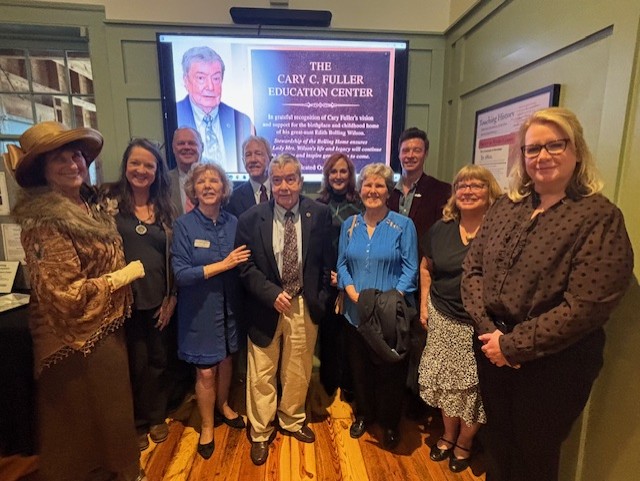
Unfortunately, I was unable to attend the celebration of the 154th anniversary of the birth of Edith Bolling Wilson, the first lady of the United States who was born in Wytheville, Virginia. However, thanks to the miracle of livestreaming, I was able to witness the wonderful 82-minute presentation from home and report on the festivities surrounding the dedication of a new educational center at the Edith Bolling Wilson Birthplace Museum on Main Street and a birthday celebration at the hotel that bears her name. Thanks also to my wonderful friend Jeremy Miller, who was kind enough to bring home some food from the event while I recovered from a kidney stone I had passed the day before. Although I had hoped to attend the dinner at the Bolling Wilson Hotel, “Have Your Cake & Edith, Too,” alongside my wife, Emily, and daughter, Bella, we were still able to enjoy a delicious catered meal of chicken cordon bleu, roasted red potatoes, macaroni and cheese, green beans, baked ziti and salmon. Yet the portion of the October 17 program I most regretted missing in person was the presentation by Benjamin Jackson, an African American historian and researcher whose work uncovered fingerprints left by enslaved children in the bricks of the Bolling home. I would have been unable to attend this presentation in person anyway, as the upstairs portion of the building is not ADA accessible. Phase II of the museum’s restoration project will include the addition of an elevator to access the upstairs of the Bolling Home. Jackson’s research offers a powerful reminder that the people whose labor helped construct Virginia’s historic homes deserve recognition alongside the families who occupied them. A Wythe County native, Jackson became involved with the Edith Bolling Wilson Birthplace Museum just over a year ago, bringing his specialized research into the search for fingerprints left by enslaved people in historic buildings. “My grandmother told me before she passed away that I would always know when I was researching the right way,” Jackson said during his presentation. “Their spirits would tell me in their own way that they were happy with what I was doing.” Before his aunt passed away, she offered him similar advice: “Always keep looking, and don’t be afraid.” Jackson also spoke about meeting museum owner Farron Smith through his wife, who sang with the Wytheville Community College choir. After the two connected during a performance in Wytheville, Smith contacted him to investigate the fingerprints within the Bolling home. “I really enjoy digging in the dirt of historical homes,” he explained. “I like the history dirt.” His closing remarks captured the importance of preserving history in its entirety. “We have to keep digging,” Jackson said. “I need to know what my ancestors went through, the good, the bad, and the ugly. Real history happens when we know the whole picture, not just the watered-down versions we get in textbooks. The people who made the fingerprints are gone, but the fingerprints they made will last forever.” Dr. Adam Manuel, the museum’s administrative assistant, further illuminated that history with an engaging presentation about Matilda Stepeau, an enslaved woman who continued working for the Bolling family after the abolition of slavery. Stepteau served as Edith’s caretaker during her childhood and later attended her wedding to President Woodrow Wilson. Her granddaughter, Zerita, went on to become one of the early African American film stars, appearing in productions including Moon Over Harlem and Mr. Washington Goes to Town. “Matilda did not just survive, she triumphed,” Manuel said, describing how her determination helped her family move beyond the racial limitations imposed upon them and establish legacies of their own. The celebration also honored Cary C. Fuller, Edith Bolling Wilson’s great-nephew, with the dedication of an educational center bearing his name. Fuller, who has demonstrated remarkable generosity toward the museum, was also the subject of a documentary by local filmmaker and historian Chris Conte. Having served on the museum’s board for three years, I witnessed Cary Fuller’s generosity firsthand. My interactions with him have always been warm and marked by extraordinary kindness. During the dedication, Fuller became emotional as he reflected on his great-aunt and his longstanding friendship with Bill and Farron Smith, whose commitment to the Bolling family’s history has helped sustain the museum. “I am so full of gratitude because without their incomparable support and their interest in the Bolling family, this museum would not exist and my great-aunt Edith’s powerful name would not endure through her hometown,” he said. “This education center bears my name and it means so much to me, but it also will mean so much to future generations.” The ceremony began with interpreter and retired English teacher Betsy Ely, who has portrayed Edith Bolling Wilson for more than a decade. Her performance offered a fitting expression of the first lady’s enduring affection for her hometown. “I have traveled all over the world, but I will always call Wytheville my home,” she said. “I am so proud to be from Wytheville.”