Zach Cooley

Tag: Millwald Theatre

RSO Holiday Brass saves Christmas

RSO Holiday Brass saves Christmas

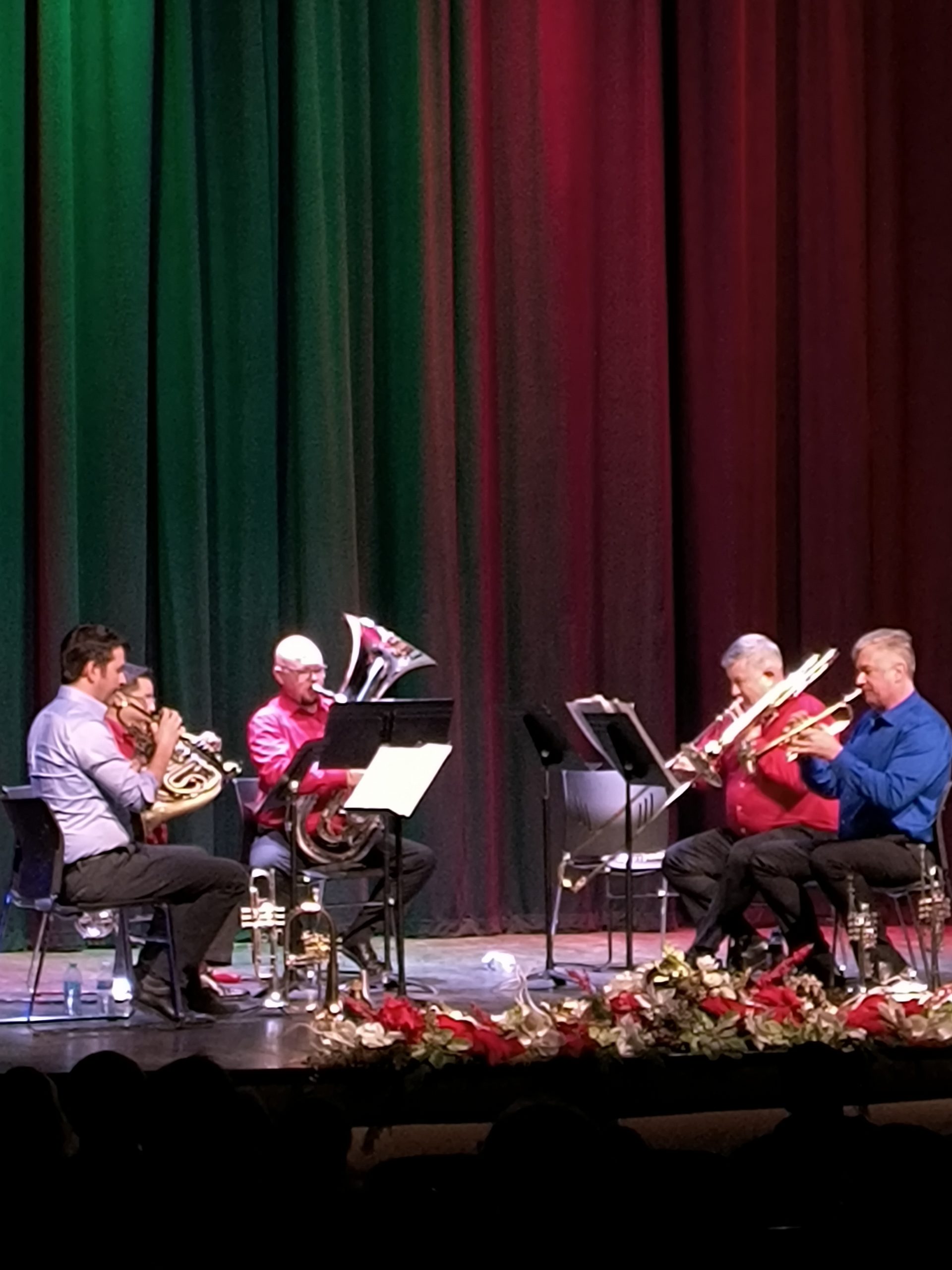
Inclement winter weather prevented the full Roanoke Symphony Orchestra from traveling to Wytheville to present the holiday pops concert we had eagerly anticipated on December 8. Fortunately, our good and faithful friends—the Roanoke Symphony Holiday Brass—stepped in to fill the gap, offering a replacement concert at the Millwald Theatre on Monday, December 15. Despite minor lift trouble with my handicap-accessible van that nearly kept my friend Jeremy Miller and me from attending, we arrived just in time. What followed was a sprightly, joy-filled 75-minute performance that flew by as effortlessly as last year’s concert had. From the opening note to the final encore, the evening was a delight. The program opened with an Aria in F Major by George Frideric Handel, led by my friend Jay Crone, principal trombonist of the Roanoke Symphony Orchestra and a trombone instructor at Virginia Tech. Crone shared a bit of musical history, noting that both Handel and Johann Sebastian Bach were dominant composers of the Baroque era. Though both were born in Germany and never met, Crone explained that their fates were linked in an unexpected way. “There was a man who fancied himself an oculist,” Crone told the audience, “who claimed he could cure blindness. He would perform surgeries and leave town before the bandages ever came off.” Bach underwent one such operation and did not live long afterward. The same unfortunate fate later befell Handel. The ensemble next performed A Rose Without a Thorn, a composition by King Henry VIII. The piece serves as a musical farewell to both his wife and his mistresses. Crone offered the audience a bit of dry humor to accompany the selection. “When King Henry VIII wasn’t preoccupied with chopping off heads,” he quipped, “he was actually composing music. He probably should have done more of that—life might have gone better for him and everyone around him.” Joining Crone onstage were Tom Bithell, principal trumpeter of the Roanoke Symphony Orchestra, and Jason Crafton, another Virginia Tech instructor on trumpet. Juan Berrios Rodriguez, a Virginia Tech musician who arrived in Southwest Virginia by way of Florida and the Dallas Brass, performed on both the French horn and the E-flat alto horn. Rounding out the quintet was tuba player Will Divers, a former student of Crone’s who now teaches in Botetourt County schools. Jazz arranger Zach Smith provided a buoyant New Orleans flavor to the first holiday medley of the evening, which featured The First Noel, Away in a Manger, and God Rest Ye Merry, Gentlemen. The unusually peppy arrangement set a joyful tone that carried through the remainder of the program. The next segment focused on holiday music from film and television. The group began with Let It Go from Disney’s Frozen, followed by Christmas Time Is Here—Vince Guaraldi’s beloved theme from the 1965 television special A Charlie Brown Christmas. The suite concluded with a medley from How the Grinch Stole Christmas, featuring Welcome, Christmas and You’re a Mean One, Mr. Grinch. I couldn’t help but wonder if I played a small role in that particular selection making its way into this year’s program. In last year’s review, the Grinch medley had appeared on the printed program but was not performed. After I mentioned it, Crone wrote to clarify that the program listed potential selections. This year, there was no printed set list, and at the conclusion of the medley, Crone acknowledged the moment. “I got yelled at last year for not getting this one in,” he told the audience. “I’m glad we could do it for you this year.” I assure readers there was no malice intended—only appreciation. If my gentle nudge helped secure that extra treat for this year’s concert, then everyone benefited. One of the evening’s most impressive moments came with a Christmas Medley arranged by German trombonist, Ingo Luis. The composition features songs in all twelve keys, weaving together carols such as Silent Night and O Christmas Tree. The arrangement blends jazz, classical, and even John Philip Sousa-style elements, making it extraordinarily complex. The Holiday Brass executed it flawlessly. The concert concluded with selections from Christmas Crackers, beginning with a mash-up of Jingle Bells and Deck the Halls, followed by Carol Fantasy, which incorporated O Come, All Ye Faithful, Joy to the World, Hark! The Herald Angels Sing, and O Little Town of Bethlehem. The final number was a jubilant New Orleans jazz arrangement of Just a Closer Walk with Thee. This was my first holiday-themed outing of the season. With the passing of my father, Christmas has arrived without the readiness of years past. Yet this concert proved more than worth the effort. My thanks go to Jeremy Miller for getting me there, Donnie Bales for allowing me to review the performance, and Jay Crone along with the Roanoke Symphony Holiday Brass for providing a much-needed measure of Christmas cheer—something that has been especially hard to come by this year.  

Strictly Observing

Millwald unveils new ‘speakeasy’

Millwald unveils new ‘speakeasy’

As I entered the Ghost Light Bourbon Bar, hidden away in the basement of the Millwald Theatre, secret password in hand, I was immediately transported back to 1928—the year this magnificent structure first opened its doors. Originally built to be a premier vaudeville theater, the Millwald never had the chance to fulfill that dream. Just one year after opening, the stock market crashed, plunging the nation into the Great Depression. Wytheville suffered like countless other towns across America. The shining new theater closed off its planned orchestra pit forever, and live vaudeville performances never took place there. For years, I had believed—and honestly hoped—that the Millwald had once been a home for vaudeville acts. Sadly, I wasn’t the only one whose dream was dashed. According to local legend, a young woman named Mary Alexander had pinned all her hopes on making her vaudeville debut at the Millwald. After the crash, she reportedly vanished without a trace. Where did she go? Did she leave town? Did she die? Did she go into hiding? Did she even exist? These questions have lingered for decades, adding an air of mystery to the theater’s history. Today, following its beautiful renovation completed in December 2022, the Millwald has become a true jewel of Wytheville. It spent decades as a beloved movie house, defining childhood memories for generations of locals—including my mother and me. Now, the addition of the Ghost Light Bourbon Bar brings a new layer of history, mystique, and allure to this iconic space. The bar’s name is inspired by the “ghost light,” a single bulb left burning on every stage to keep actors safe in a dark theater. But here, the term takes on a more literal meaning. There are numerous ghost stories surrounding the Millwald. Tales circulate of children whose favorite place was the theater, and of former staff members so devoted to their work that perhaps they never truly left. And then, of course, there’s Mary Alexander. Some believe her spirit still lingers—either within the theater itself or in the secret space now known as the Ghost Light Bourbon Bar, rumored to have once been her dressing room. The idea for this hidden space came from Technical Director Suzy Booth and Executive Director Donnie Bales. They envisioned a separate, exclusive area where patrons could enjoy an intimate experience apart from the theater itself. “Given the Millwald’s history, a speakeasy just made sense,” Suzy told me during our conversation on September 27, as we sat surrounded by the bar’s rich atmosphere. “When we first started, this was just a plain beige room,” she explained. “We chose the red velvet curtains, painted the walls a deep green, and brought in mismatched, vintage-inspired furniture to give it character.” The décor includes an old film projector, books from the early 1920s, and dim, intimate lighting that evokes the Prohibition era. Though the Ghost Light Bourbon Bar is part of the Millwald, Suzy emphasized that they wanted it to have its own identity and vibe. On certain nights, silent movies are screened for guests. Most recently, Wytheville native Chase Altizer became the bar’s first live performer, playing to a packed audience of 35. The upcoming screening of the original Nosferatu has already sold out. “We’re still figuring out what all we can do in this space,” Suzy said with a smile. “It’s been exciting to see how people respond.” Bartender Mike Ambrose moved to Wytheville nine months ago from Bakersfield, California. In addition to serving drinks, he helped with the painting and restoration of the bar. The menu, curated by Brenton Underwood, is a tribute to the Golden Age of Cinema, Prohibition, and of course, the legend of Mary Alexander. Each cocktail is steeped in history and storytelling. The Millwald ‘28 is comprised of Tanqueray gin, lemon, Aperol, prosecco, and dried rose petals. The Method is a concoction of Maker’s Mark, house-made brown sugar syrup, Angostura bitters, black walnut bitters, dehydrated blood orange wheel, and soda. Matinee Mischief combines Tito’s vodka, house grapefruit syrup, lime, dehydrated lime wheel, and a Himalayan salt rim. Mary’s Prescription blends Maker’s Mark, Domaine de Canton, lemon, sugar, bitters, and dried rose petals. A wide variety of bourbons, wines, beers, and champagnes are also available. From the moment I entered through the secret door, I was completely captivated by the space. The dim lighting, deep red curtains, and the smooth sounds of Nat King Cole and Frank Sinatra transported me to an era I could only dream about, and here I was, living it. I’m deeply grateful to Suzy Booth and her husband, Dustin, for sharing their vision and passion for this project. This remarkable space is certain to become a favorite hangout for locals and visitors alike. To be part of its magic, you must join their mailing list at www.ghostlightbourbonbar.com to receive updates and access. I’m so glad I did. I’m also thankful to Mike Ambrose for his warm hospitality and conversation, as well as to Donnie Bales for giving me the chance to experience this hidden treasure. There is a $5 cover charge for entry, with special events carrying their own ticket prices. For me, the accessibility of the space made the evening even more meaningful—I was able to reach it easily by elevator. After all, no place is truly worth visiting unless everyone is given the chance to experience it. The Ghost Light Bourbon Bar is more than just a speakeasy. It’s a living piece of Wytheville history—a space where past and present meet beneath the glow of a single lightbulb. I look forward to watching its story unfold, and perhaps, to finally uncovering the truth about the mysterious Mary Alexander. Until then, I know this is a place I will return to again and again.

Strictly Observing

Perfect night for symphony

Perfect night for symphony

Sunday, September 14th was an evening made to order. The weather cooperated perfectly—warm, around 80—setting a stage that felt cinematic before a single note was played. The Roanoke Symphony Orchestra, in full force, took the stage at Elizabeth Brown Memorial Park in Wytheville for a one-of-a-kind concert facilitated by the Millwald Theatre. Several hundred people gathered; my wife and I were among them, enjoying a rare date night. After a satisfying meal at Burger Express on Main Street, we strolled along the beautifully bricked Heritage Walk toward the park. By the time we arrived, twilight had settled in, and the mood was just right. The concert, in two acts lasting about 67 minutes in total, opened with the stirring strains of The Star-Spangled Banner, featuring the Roanoke Symphony Orchestra Chorus. Maestro David Stewart Wiley, who leads the Roanoke Symphony, greeted the audience with warmth. “We are honored to be your orchestra,” he said. “We are an ensemble whose geographic reach is among the largest in Virginia.” What followed was a program that wove together patriotic fare, popular film scores, and adventurous percussion—all delivered under a spacious, open sky. One of the evening’s most inventive features was the group Plastic Music, who served up drums made of plastic and sticks fashioned from drain-pipe, along with boomwhackers—tubular percussion instruments pitched to different notes. Their work in In the Hall of the Mountain King shone: those unusual instruments added texture and surprise, carrying through later numbers as a recurring highlight. Next came a five-minute medley from Titanic (1997), composed by James Horner. The Roanoke Symphony tackled both the sweeping oceanic beginning and the impending danger of the iceberg, building toward the iconic My Heart Will Go On. Principal oboist William P. Parrish Jr. was featured beautifully in that latter part; his clarion tone added poignancy to the melody. Patriotic tunes held center stage next: a spirited pairing of Yankee Doodle and You’re a Grand Old Flag, presented under the banner of Star-Spangled Spectacular by George M. Cohan. Later, they performed God Bless America and an Armed Forces salute. These numbers were colored by the rich voice of Mayar Moneir, who also delivered stirring renditions of You’ll Never Walk Alone, Feeling Good, and even Dolly Parton’s Jolene—a nod to country classicism amid the evening’s eclectic mix. The first act wound down around the 45-minute mark; the second, shorter roughly 20 minutes, opened in striking fashion with Gioachino Rossini’s William Tell Overture, once again featuring Plastic Music’s boomwhackers. One of the evening’s climaxes came with a rendition of Led Zeppelin’s Kashmir, featuring a blistering electric guitar solo by Mike Havens. Maestro Wiley had high praise. “Mike is a wonderful educator, a great guitar player, and an all-around wonderful human being,” he said. Another highlight was The Raiders March from Raiders of the Lost Ark, John Williams’s adventurous and instantly recognizable theme from the 1981 film. It opens with a bold brass fanfare, has sweeping strings, woodwinds, and the sort of rhythmic drive that captures both daring and grandeur. It’s classic Williams—heroic, cinematic, and full of energy. Toward the end of the program, the audience was treated to Alexander Borodin’s Finale from Polovsian Dances, a suite from the 19th century opera, Prince Igor. A Russian composer by night, Borodin serves as a chemist at his day job. Maestro Wiley also took time to reflect on the community and connections. He spoke of Wytheville’s history of collaboration with the Roanoke Symphony, citing Wytheville as the hometown of Ashley Hall, who got her start in the Youth Symphony and later joined Canadian Brass. He also praised Dolly Parton—not simply for her songs, but for her generosity, particularly her Imagination Library, which has given widely to her home region. In summary, Emily and I enjoyed a very special evening. We are deeply grateful to the Millwald Theatre, the Roanoke Symphony Orchestra, and Elizabeth Brown Memorial Park—not just for the beautiful atmosphere but for the unforgettable artistry. It was a night we will always treasure. I also want to thank friends at the Millwald—Mastin Paisley, Donnie Bales—for making sure I was part of this event. Supporting what they bring to our community is one of the highlights of my life and career.  

Strictly Observing

Atlanta Rhythm Section rocks Millwald

Atlanta Rhythm Section rocks Millwald

Twenty years ago, the Atlanta Rhythm Section lit up the Chautauqua Festival in Wytheville in what was promised to be one of the most exciting performances our hometown summer tradition had ever seen. By all accounts, it was. Unfortunately, I missed it—my father was undergoing open-heart surgery in Cleveland, and I was staying with a relative who couldn’t take me to the show. Two decades later, I finally had another chance to see this legendary rock ’n’ roll group in my hometown. This time, it was in the beautifully restored Millwald Theatre, playing to a sold-out crowd of more-than-enthusiastic fans—many of whom had waited as long as I had, and some even longer. I had the added career highlight of interviewing the band’s original lead singer, Rodney Justo, before the event. He assured me I would not be let down. That turned out to be a serious understatement. The Atlanta Rhythm Section delivered a non-stop, 90-minute set of pure rock and roll. They started at 7:30 on the dot on Saturday, August 9, and didn’t let up until the last note rang through the Millwald. “We’re not a band who jumps around the stage or does a lot of gimmicking,” Justo told the crowd. “We play and sing songs—that’s our job. We come on stage, we do our job, and that’s it. We have a good time doing it, and we want to make sure the audience has a good time as well.” As my Aunt Hazel would say, a good time was had by all. The Atlanta Rhythm Section has been steadfast for 56 years, and their fans have been equally loyal. One woman sitting behind me—barred from sneaking backstage—waited after the show to tell Justo, “I fell in love with you all when I was 12 years old. I’m 61 now, and I’m still in love.” Every one of the dozen-plus songs blended high-energy rock with the soul and blues edges that make ARS impossible to pigeonhole into a single genre. “Some people like to say we’re a Southern rock band,” Justo said. “But we don’t sing about trailer hitches and Jack Daniels. We like to sing songs with a clear message from beginning to end—musically and lyrically.” Opening with “Homesick” and “Champagne Jam,” the band treated the crowd to “Spooky”—a nod to the Classics IV, the band from which ARS was formed. “Half of us came from the Classics IV,” Justo explained. “The other half came from Roy Orbison’s backing band, The Candymen.” The set rolled on with “Doraville,” their tribute to hometown Georgia, followed by rousing dance numbers “Large Time” and “Boogie Smoogie.” “I’m Not Going to Let It Bother Me Tonight” was paired with a medley of “Do It” and “Angel.” Then came “Crazy,” and finally, their 1977 Top 10 hit, “So Into You,” which featured a blistering five- or six-minute guitar solo from Steve Stone that brought the crowd of 500 to its feet. From my front-row seat, I had a direct view of guitarist David Anderson, whose shimmering gold electric guitar matched his flawless playing. Drummer Rodger Stephan drove the evening forward with riveting licks, while bassist Justin Senker kept the funk alive and keyboardist Lee Shealy added the bluesy textures. Before launching into another of their biggest hits, Justo grinned and said, “The Atlanta Rhythm Section is the only band in history who can predict the future. Everybody wants a selfie with us these days—we were writing about selfies decades ago. Back then, we just called it ‘Imaginary Lover.’” That tune sent the band offstage to a roaring ovation before they returned for one last electrifying number: “Back Up Against the Wall”—the perfect closer for Wytheville’s rock ’n’ roll party. I’m grateful to my friend Jeremy Miller for getting me to the show, and to Donnie Bales, Lydia Showalter, and Mastin Paisley at the Millwald Theatre for ensuring this night was a career highlight—from the concert to my interview with Rodney Justo. Meeting all the current members of ARS was an honor. Justo, still holding his own at 80, and the rest of the band—none under 50—played non-stop jams for the entire set. They may not be household names like some who’ve passed through ARS’s ranks, but these men have spent decades—three, four, even five—keeping the band’s legacy alive with the highest class and talent. Here’s hoping they make good on their word and return to Wytheville. If they do, it will be our reward.  

Strictly Observing

Beloved Wythe teacher and friend passes away

Beloved Wythe teacher and friend passes away

The reality that my dear friend Frances Watson has passed away still hasn’t fully sunk in. Even though she lived 82 years, she strikes me as someone who was too young to leave this world. That’s because Frances was ageless. She was the same vibrant, witty, and kind-hearted person from the very first time I remember meeting her—early in my own life, which has now spanned over 40 years. I never had her as a teacher at Spiller Primary School, but everyone wished they had her. And it wasn’t just because she was beloved—it was because she made every moment feel like something special. Frances didn’t need a school-wide play for her students to experience joy. She put on plays—with her own class, no less—in front of the entire school. I can still remember being in second grade, obsessed with the story The True Story of the Three Little Pigs—the one where Alexander T. Wolf explains how he was framed. And who do you think played the wrongly-accused, over-the-top wolf, pleading his innocence in our school’s version? Frances, of course. Larger than life. Stealing the show. And then there was third grade, when Billy Ray Cyrus’s Achy Breaky Heart was topping the charts. Frances’s class did a pantomime of that song, with the student playing Billy Ray picking Frances from the audience to dance with him. For 60 years, she and her husband Graham ran one of the finest farms in the county from their home in Max Meadows. I’ll never forget one day when she walked past me in the lunchroom and saw that I hadn’t touched my milk. “You’d better drink that milk,” she said, looking me dead in the eye. “That cow gave its life so you could have that milk today.” Needless to say, I left lunch with a very dry, very empty milk carton. But it was later in life that I was lucky enough to become Frances’s friend. We bonded over our support for the Wythe County Public Library, and through that shared passion, we met our mutual friend Anita Libby. It was Anita who called me to say that Frances had taken a fall and wasn’t expected to live another 24 hours. And it was Anita who first told me that Frances had passed. I called her back immediately to offer my deepest condolences, because Frances wasn’t just a friend to Anita—she was like a sister. And Frances proudly called Anita the same. Just a few months ago, Frances told me she wanted to attend an event at the Millwald Theatre with me. I promised her we’d make it happen. I also promised her a part in the stage play I’ve been working on, based on my first novel in 17 years, Open Secret. I wrote a role just for her—a sister character named Frida, who would appear opposite the main character, to be played by Anita. When I sent Frances an early draft of the script, she raved about it. “What an honor it would be to be in your first play,” she wrote to me. “I absolutely loved the part. Because, as you know, Anita is like my sister, and I love telling her what to do.” I’m so sorry I let you down, dear friend. I’m sorry we never made it to that Millwald show together. I’m sorry you never got to be in the play. But rest assured—it will not happen without you. I’m sorry you never got to read the book with the character I wrote for you. I’m sorry I never got to sign you a copy. There was no bigger supporter of the arts in Wythe County than Frances Watson. She championed the Millwald Theatre. She never missed a show when my wife sang at the Bolling Wilson Hotel. I remember once after my wife sang, Frances came up and said, “If you sang that well, honey,—you deserve a little bit of wine.” Then she produced a goblet bigger than a fishbowl, drained the contents of her bottle into it, and offered it to my wife. “You realize if you drink that,” I warned her, “you won’t be able to drive us home… or get through your next song.” It was just Frances being Frances—joyfully generous, unapologetically full of life. She was ageless because she never stopped living. You wouldn’t have known—just two days before her passing—that she was on the verge of a brain bleed. You wouldn’t have guessed she was 82. She was vibrant until the end. And she wanted the people around her to be just as alive. From the thousands of students she inspired, to her beloved grandchildren, to her many family members and friends—Frances leaves a void that no one else could ever fill. When I think of her, I think of sayings like: “Dance like nobody’s watching.” “Live every moment like it’s your last.” Except Frances didn’t dance like no one was watching. She wanted everyone watching—not for attention, but to show us all how to squeeze every drop out of life. No one lived a fuller life than Frances. And no one set a better example of how to seize every moment we’re given. So from now on: When I attend a Millwald Theatre show… When my wife reaches for a sip of wine… When I sign a copy of Open Secret… …those things will be done in memory of Frances Watson. I know that when I’m singing loudly to my favorite song, or laughing a little too hard at a friend’s joke—Frances will be there. In spirit. In laughter. In joy. And in every moment we choose to truly live.  

Uncategorized

Rhea brings laughter to Wytheville

Rhea brings laughter to Wytheville

Saturday, June 14, was a wild night in Wytheville, Virginia, as stand-up comedian Caroline Rhea took the stage at the historic Millwald Theatre for an evening filled with raucous laughter—and a touch of culture shock. The Canadian-born star, best known for her role as Aunt Hilda on Sabrina the Teenage Witch, now lives in Los Angeles. She admitted she’s never been more frequently corrected on the pronunciation of a town’s name. “Wytheville” quickly became a running gag during her 77-minute set. Though her onstage persona couldn’t be further from the family-friendly character she’s famous for, a few determined teenagers managed to slip into the mostly 21+ crowd to see their favorite TV star. Rhea acknowledged the jarring contrast. “It’s a little like finding out your kindergarten teacher is a stripper,” she quipped. In addition to finally learning how to pronounce Wytheville, Rhea took delight in the surrounding towns’ unusual names—like Ivanhoe and Galax. The latter particularly tickled her. “Why that name hasn’t been used for an enema, I’ll never know,” she said with a grin. As always, Rhea’s humor blended self-deprecation with observational wit. “I’m very codependent, and I worry about the world,” she confessed. “When my friends laugh really hard, I pee in their pants.” Honestly, I wish she could have done that for me. The laughter took over my disabled, slightly incontinent body—a mess my wife had to help clean up when I got home, unfortunately. The presence of such a seasoned comedy and television veteran should have made for an instant sellout at the Millwald. That it didn’t was disappointing—both for our town and the comedian herself. “I’m not quite sure why the whole town didn’t show up tonight,” she said shortly after walking on stage. “I spent the day exploring, and from what I saw, it’s not like there are many other entertainment options around here.” A longtime lover of garage sales, Rhea found one local business particularly intriguing. “After the show, we’re all breaking into JoJo’s Attic so I can grab those antiques I saw and couldn’t buy,” she joked. “I’m running low on picture frames. I only have 2,000.” Her comedic style thrives on audience interaction. She playfully asked several attendees their zodiac signs. As fellow Aries, she and I apparently have a lot in common: namely, a tendency to start ten different stories and finish none. It made for an erratic, but highly entertaining, performance. Like me, she’s the parent of a single daughter—one she lives to please, but who often finds her embarrassing. “It’s really not our fault,” she explained. “It’s nothing personal against us. It’s just the way our children see us.” Her obsession with astrology was a recurring theme throughout the show. “I had an emergency C-section because I was at high risk of giving birth to a Scorpio,” she said. “I didn’t want to raise a daughter who was that good at sex and that unwilling to forgive.” The 61-year-old comedian also shared candid—and hilarious—tales from her dating life after 50. “I went on a blind date with a guy who had a lazy eye,” she told us. “We broke up soon after because he was seeing someone else on the side.” She paused, then added, “That joke would be even funnier if it weren’t a true story.” She also recalled a moment involving her health-conscious diet and an innocent-looking spoonful of peanut butter she found on her sister’s kitchen table. Thinking it was a healthy 12 grams of protein, she helped herself. Moments later, her sister returned. “I know I left a spoonful of peanut butter here,” her sister said. “I put the dog’s medicine in it and everything.” “At that point, I became a full-fledged dog in five minutes,” Rhea recalled. “I was scooting my butt in circles across the rug and peeing on her bedroom floor for months.” “I feel sick,” she told her sister. “Well, at least you’re not going to get ringworm,” her sister replied. Rhea’s opening act was 30-year-old CJ Marer, a struggling actor and comedian currently living in the Los Angeles area. Originally from a small town in Rhode Island, Marer quickly established his underdog charm with the audience. He recounted his only audition for a Hallmark movie. “I auditioned for the male lead, which basically meant I had to stay shirtless and do all the handyman work throughout the film,” he explained. “When I took off my shirt, the directors winced.” He mimicked the casting conversation: “Did you expect him to really be that pale?” one director asked the other. “How can he be skinny and fat at the same time?” Marer joked that most of the roles he plays. “I usually show up at the beginning of the movie to ask who the guy is she’s talking to,” he said. “By the end, I’m either dumped or dead. That’s the extent of my acting career.” He described one particularly rough patch when his apartment was broken into—but nothing of his was stolen. Instead, the burglars left behind a note and a watch they’d apparently taken from somewhere else. The note read: ‘We realize times are hard for you right now. Take care of yourself. If you ever want to join us, we’re looking for other guys to help us with jobs.’ “My roommates were mad,” he said, “but I had a new watch and a job interview—two things I didn’t have before the robbery.” Marer was a particular hit with the female members of the audience, earning more than a few catcalls and whistles during his time on stage. All in all, it was a thoroughly entertaining night—and a relatively historic one in Wytheville’s entertainment history. For me personally, it was a true honor to meet both comedians and to interview Caroline Rhea for my podcast. She couldn’t have been more gracious and generous with her time. It was, without question, a career pinnacle. To listen to the full interview, follow this link: https://www.youtube.com/watch?v=rg5-9Yveqrw  

Strictly Observing

Parker makes theatrical debut with Wythe-Bland Foundation film

Parker makes theatrical debut with Wythe-Bland Foundation film

On the evening of Saturday, June 7th, my family and I had the honor of attending the 20th anniversary celebration of the Wythe-Bland Foundation at the historic Millwald Theatre. A capacity crowd gathered to celebrate this remarkable local organization, which has tirelessly dedicated itself to advancing the education, health, and wellness of our community. Executive Director Travis Jackson explained that the Foundation was born out of a leasing agreement between Wythe County Community Hospital and LifePoint Health. This strategic move has allowed our local hospital to offer specialized services and diagnostic imaging that previously required travel to cities like Roanoke or Bristol. Thanks to the Foundation, organizations such as the Brock Hughes Medical Clinic and the Bland County Medical Clinic can provide high-quality care and critical medical testing to patients in need—care that would otherwise be inaccessible. The Wythe-Bland Foundation’s impact extends far beyond healthcare. It has played a vital role in supporting our children’s education and well-being. Thousands of local children receive free dental cleanings and exams, and through the Dolly Parton Imagination Library, they’re given the gift of books. The Foundation also makes possible field trips that enrich learning experiences and spark curiosity—opportunities many students would otherwise never have. In total, the Wythe-Bland Foundation has provided over $48 million in funding for a variety of transformative initiatives throughout our region. And on a personal note, I can attest to the profound difference this organization has made in my life. They’ve awarded scholarships that allowed my family and me to experience the health benefits of the Wytheville Community Center. They funded my wife’s participation in the “Fit for Life” program back in 2013 and have provided meals for us through the Open Door Café. My daughter is one of over 1,500 students who have received Hope Packs from Spiller Elementary School, giving her additional weekend nutrition at no cost. For an inter-abled family living on a fixed income, these are not small blessings—they are life-changing. While my gratitude to the Wythe-Bland Foundation runs deep, the main reason I attended the event was to witness the premiere of a powerful 35-minute documentary chronicling the Foundation’s past and vision for the future. This exceptional film was crafted by one of my dearest friends, Cory Parker, owner and operator of MountainCAP Media. Cory’s film was nothing short of extraordinary. With a filmmaker’s eye and a native son’s heart, he captured the breathtaking beauty of Wythe and Bland Counties in ways that even the most elite studios might struggle to match. His aerial drone shots of the Wytheville Water Tower and Big Walker Lookout were simply awe-inspiring. The message was clear and compelling: Southwest Virginia is not just a place to live—it’s a place to love and call home. Through poignant visuals and heartfelt storytelling, Cory illuminated the selfless work being done right here in our backyard. His work stirred emotion, evoking tears of gratitude for the people, places, and institutions that make this region special. Cory Parker is not only a genius behind the lens but also a truly exceptional person with a heart as big as his talent. The tribute he created to honor the Wythe-Bland Foundation, and this community is one that should elevate his name in the eyes of all who view it. As one of Wythe County’s finest residents, I couldn’t be prouder to call Cory a close friend. His generosity and skill are unmatched. In fact, he previously lent his talent to create a full-length concert video of my wife’s Tina Turner tribute show—a project that helped earn her a spot in the Chautauqua Festival lineup. So when Cory personally invited me to the debut of his latest cinematic achievement, I knew I had to be there. As we sat side-by-side in the Millwald Theatre, I noticed tears welling in Cory’s eyes as he watched his labor of love unfold on the big screen. It moved me deeply. I know the dedication he pours into his craft, and I know that his vision, artistry, and passion are truly one-of-a-kind. Wythe County may not yet fully realize the treasure they have in Cory Parker, but I hope this film will help change that. I certainly left the theater feeling immense pride, not only in my friend, but in this community we call home. It’s also humbling to reflect on the fact that the Wythe-Bland Foundation was formed the same year I began writing this column for our local newspaper. In the two decades since, we’ve all tried, in our own ways, to make a meaningful impact on the place we love. Considering everything our area—and the world—has experienced in those years, it’s astounding to see how far we’ve come. We remain a united community, filled with people who choose to be dream-makers rather than dream-crushers. That was the central theme echoed by the event’s keynote speaker, Jim Morris—the former professional baseball player whose inspiring story was immortalized in the 2002 Disney film The Rookie, starring Dennis Quaid. Speaking after the film’s conclusion, Morris praised the Wythe-Bland Foundation with heartfelt admiration. “This is a real community of dream-makers,” he said, borrowing from the title of his memoir. “This is a community that really cares about its people. I didn’t grow up in a place like this.” I did. And for that, I am forever grateful. To be a disabled person who’s been given a chance to have a meaningful career, to give back to the community I cherish most, is an immeasurable gift. Watching Cory Parker’s beautiful film, I was reminded once again why this is—and always will be—home.

Strictly Observing

Yacht Rock wows Millwald

Yacht Rock wows Millwald

Yacht Rock Schooner made its triumphant return to the Millwald Theater on Friday, March 28th. Despite not receiving the sellout they deserved, the Wytheville crowd gave an uncharacteristically enthusiastic response, which made it feel like a full house. Named after a genre for the easy rock of the late 1970s and early 1980s, the term “Yacht Rock” swept the world by storm after a YouTube craze twenty years ago spoofed a fictitious meeting between Michael McDonald and Kenny Loggins and their subsequent creation of the song “What a Fool Believes.” However, Yacht Rock Schooner offered nothing during its 2-hour show that resembled easy listening. Instead, they delivered a 25-song set list that showcased the rock and soul blend of pop music during an era when flashy trends and a lack of talent did not overrun the mainstream. Back then, pop music had to be polished and inventive to become number one, and these eight musicians from Atlanta, Georgia, showed us exactly how the professionals did it in an electrifying evening filled with songs by the Bee Gees, Steely Dan, the Little River Band, Michael McDonald, Jackson Browne, and many others. Each of the eight members walked out on stage with the presence of an artist who could carry their own show. No doubt they could have, but together, they were on fire. Brenda Nicole Moorer brought a soulful touch to numbers like Fleetwood Mac’s “You Make Lovin’ Fun” and “Thunder Only Happens When It’s Raining,” that Stevie Nicks and Christine McVie would surely envy. Moorer’s rendition of Barbra Streisand’s “Guilty” had an R&B edge that Streisand could only wish for. Her performance of Carly Simon’s “You Belong to Me,” with its sultry feel, brought half the audience to their feet by the end. Her fellow vocalist, Cleveland P. Jones, matched that soul on songs like the Doobie Brothers’ “Taking It to the Streets,” the Bee Gees’ “Nights on Broadway,” and Steely Dan’s “Peg.” A highlight of the show for me was drummer Ganesh Lee’s impeccable drumming and unstoppable vocals on two of my favorite numbers: Hall & Oates’ “I Can’t Go for That (No Can Do)” and Kenny Loggins’ “Heart to Heart.” He delivered show-stopping performances in both areas. My lifelong hero, Phil Collins, has often said that singing behind the drum kit is difficult. Lee exploded that theory, effortlessly delivering Loggins’ breathy tenor and soulful growl while maintaining tireless drumming. To watch his swagger and precision at the drum kit was an awesome sight. At the very least, he never missed a beat and was the driving force behind the band, proving he could lead it with zero struggle. Described by Lee as the “blunt force trauma” of the band, saxophonist Jordan Shaloup stole the show several times, especially during the iconic solo in Gerry Rafferty’s “Baker Street.” The final song before the encore, someone shouted a request for the song just as the band was gearing up to play it. It was the perfect cherry on top after the band flawlessly performed two of my other favorites during the evening. When I thought Lee couldn’t top his performance of the Hall & Oates’ dance favorite, he launched into the fabulous yet rarely heard Kenny Loggins track “Heart to Heart.” We had a brief conversation a few days before the show, and I had to ask him if he had Loggins ready to play. “You know it,” he assured me. When that number kicked off, I flattered myself by thinking maybe he had me in mind as he played it, knowing I’d be in the audience. In fact, I wouldn’t have been there if Ganesh Lee hadn’t secured spots for my family and me. Interviewing him for his appearance at the Millwald Theater last year was one of the most exciting interviews I’ve ever had in my career. For him to invite me and my family to see the show was more than just an unforgettable evening—it capped off my week-long celebration of turning 40. Not only did he add to the festivities, but he also reminds me I could still be cool, even at an “over-the-hill” age. If I possessed even half the smoothness Ganesh Lee displayed onstage that night—right down to the hair and sunglasses—I’d never have to worry about going out of style. All the clichés about drummers catching the eyes of the ladies and the admiration of the guys came to life when you watch him perform. I am incredibly grateful for the opportunity to see this unbelievable show. I was also happy to bring my Aunt Pam along. Although she has spent her adult life in Raleigh, she returned to her native Wythe County to help me celebrate my milestone birthday. Having spent much of her childhood at the Millwald, she was eager to see its renovation and its continued success as a production house. She couldn’t have been more impressed with the results. We even had dinner at a revitalized version of another hangout from her teenage years, Burger Haven. The delicious food brought her back in time, and we topped it off with wonderful desserts from Frozen in Time. I hope that Yacht Rock Schooner will return to Wytheville soon. It’s a one-of-a-kind experience that music lovers can only fully appreciate in person. These musicians are top-tier, and in a single evening, they turned our sleepy little town into the most happening place in America.  

Strictly Observing