
Byrd remembrance brings ‘tears from God’
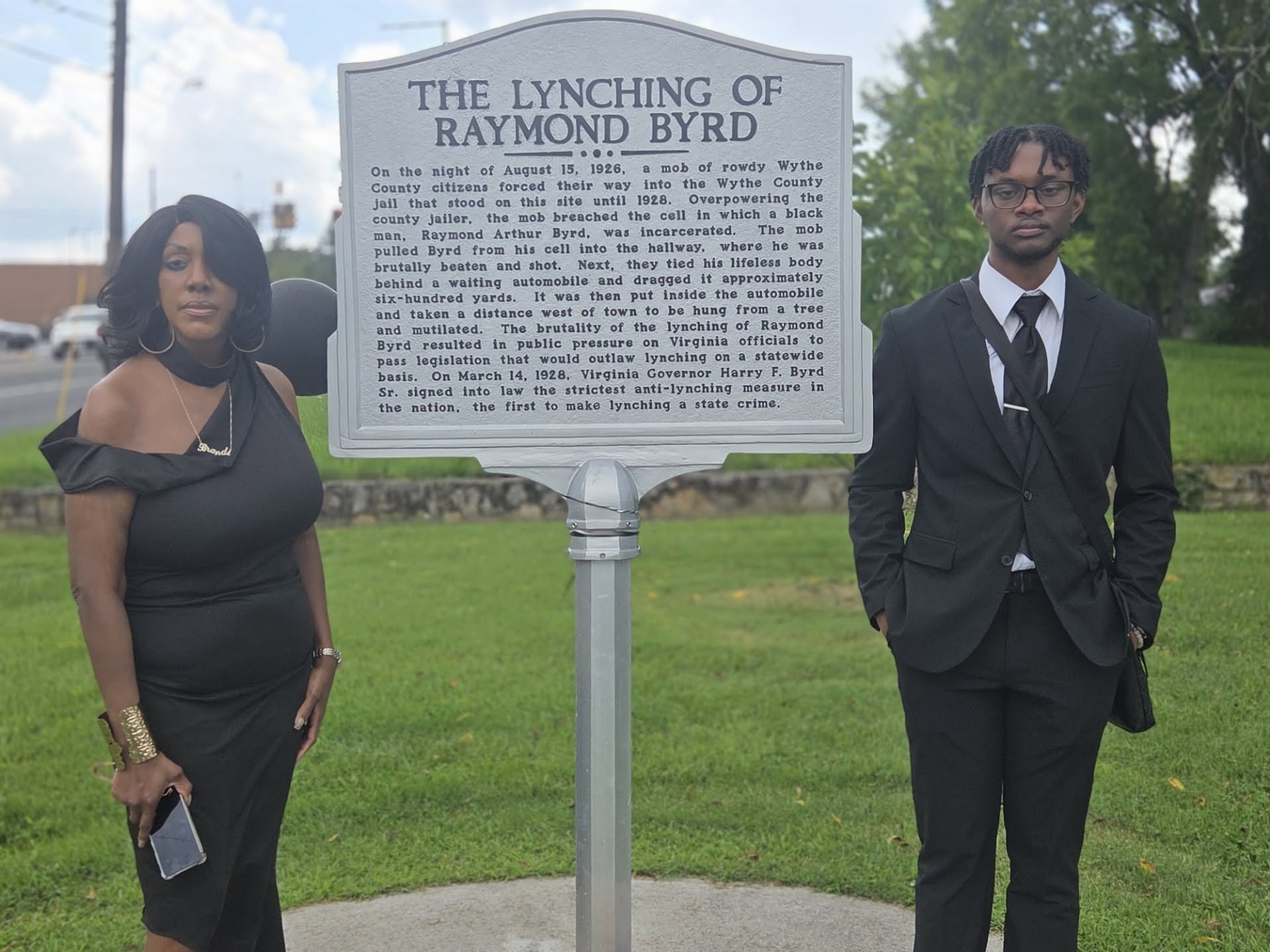
Patricia Austin called the torrential downpour that fell on downtown Wytheville as approximately fifty of us gathered to commemorate the centennial anniversary of one of the darkest chapters in our local history “tears from God.” One hundred years earlier, on Aug. 15, 1926, a 31-year-old Black man named Raymond Arthur Byrd was attacked, beaten, shot and lynched by an angry mob of white men from Wythe County. Byrd had been accused of a sexually assaulting a white girl, after which a group of racists took matters into their own hands and committed the unspeakable act of violence. Today, a historical marker commemorating Mr. Byrd’s life and legacy stands in front of the site of the old Wythe County Jail, where he was held before being taken by the mob. “We stand here not only to remember the injustice, but to confront the truth of what happened,” said Austin, executive director of the Wytheville Training School and Cultural Center. “This ceremony is an act of courage, an act of community responsibility, and it is an act of love for justice and a love for the future that we are building together.” The lynching of Raymond Byrd sparked statewide and national outrage and left generations of his family to live with the trauma of a failed justice system. Standing beside the marker, Byrd’s great-granddaughter, Brandi Quinn, wept as the tragedy that had been carried through generations of her family, was recounted. Her son, Raymond Byrd’s great-great-grandson Braylin, read a poem written by Byrd’s widow sometime after her husband’s horrific death. Overcome by emotion, he, too, shed tears. Braylin is currently attending college in Ohio going into his Junior year as a Political Science Major and Communications Minor. He was also elected Senator at Large on his campus. Raymond Byrd’s widow, Tennessee Hawkins Byrd Patterson, lived only 15 years longer than her husband, dying of malignant hypertension at the age of 39 in 1941. According to research presented during the ceremony, she had been refused medical treatment by white doctors in Wythe County. Dr. Thomas Edge, teaching professor of ethnic studies at Bowling Green State University, presented extensive research on Raymond Arthur Byrd, his tragic death, its effect upon his family and community, and the continuing search for acknowledgment and truth. A feature-length documentary on the story is also being planned. “My goal is not simply to recount the horror of what happened,” Dr. Edge said. “My goal is to continue the legacy of the family and to note how they coped with the trauma of such a horrible ending to their ancestor’s life.” One of the most emotional portions of the presentation focused on Hazel Byrd Hayes, the daughter of Raymond and Tennessee Byrd. In an effort to help her family, Hazel reportedly lied about her age to join one of the first female military units during World War II in order to send money home to help her siblings. Following her military service, she joined the Great Migration north and eventually built a successful career as a beautician in Ohio. “She not only had to deal with the tragedy of her father’s death, but also her mother,” Dr. Edge pointed out. “The fact that her mother died at an extremely young age after being refused medical treatment by white racists was equally traumatizing for the young woman.” It was not until a decade after Raymond Byrd was killed that his widow could apply for a military headstone for him. In 1936, the law was changed to allow qualifying military veterans to receive a government-issued headstone. Before then, victims of racial violence were often buried in unmarked graves. Brandi Quinn is the only grandchild of Hazel Byrd Hayes, who often shared with her granddaughter both the beauty of Virginia and the pain of living in a community that constantly reminded her of the father she lost when she was only 2 years old. “My grandmother shared with me so many things about the beauty of Virginia,” Quinn said. “But she also shared with me the difficulty of living in a community that constantly reminded her of the loss of her father.” A World War II veteran, Hazel Byrd Hayes moved north to Toledo, Ohio, where her family continued to grow and thrive. Today, her granddaughter and great-grandchildren carry on that legacy. Her great-grandson bears an uncanny resemblance to his great-great-grandfather, and it was a privilege to be introduced to this family. They approached the commemoration of an unspeakable family tragedy with tremendous grace and class and it was a singular honor to meet them. “Thank you for greeting us with warmth and love,” Brandi Quinn said. “We will carry you in our hearts back to Toledo with us.” Being part of such a ceremony is something my wife Emily and I will never forget. Despite the horrors of racism that still exist today in this community, there was something profoundly moving about witnessing such an outpouring of humanity. People stood together in the pouring rain, united by the belief that the truth matters and that the life of Raymond Arthur Byrd matters. May his soul rest more peacefully in the knowledge that there are those who will not forget his life, his struggles or the injustice inflicted upon him. May we never forget the plight of any human being who is treated as though they are somehow less worthy than another. And may the truth of Raymond Arthur Byrd’s story, and stories like his, never be lost on those who continue striving to make humankind better through the way they choose to live their own lives. Remembering is not enough if it changes nothing. It is where the responsibility begins.